You’ll find that a normal forehead temperature ranges from 31.0°C to 35.6°C (87.8°F to 96.1°F), which is consistently lower than core body temperature. This variation occurs because forehead readings don’t measure internal temperature directly. Your forehead temperature typically runs 0.4–0.5°C below ear measurements and differs from oral readings. A fever on your forehead registers at 38°C (100.4°F) or higher. Understanding how thermometer type, calibration, environmental conditions, and measurement technique influence your results reveals why accuracy matters.
Understanding Forehead Temperature Ranges
When you’re measuring forehead temperature with an infrared thermometer, you’ll find that normal readings typically range between 31.0°C and 35.6°C (87.8°F to 96.1°F) in adults—noticeably lower than the widely cited core body temperature of 98.6°F (37°C). The median forehead temperature centers around 33.3°C ± 1.18°C (91.94°F ± 2.12°F), reflecting normal physiological variation. Device selection markedly impacts your measurements; different thermometers may vary by 0.5°C to 2°C due to calibration differences and skin emissivity adjustments. Clinical-grade devices apply mathematical corrections to approximate core temperature, whereas consumer-grade infrared thermometers often report lower surface readings. Understanding these variations helps you interpret your forehead temperature measurements accurately and distinguish normal readings from genuine fever indicators.
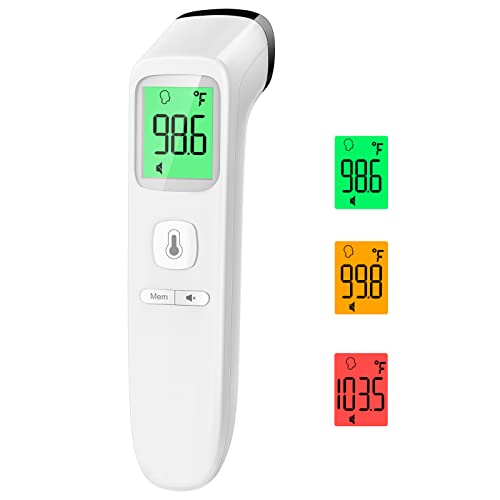
Reliable & Accurate: Goodbaby Forehead Thermometer has been clinically tested and found to be a fast and absolutely reliable gadget to use. It is ideal for forehead readings.

No-Contact Thermometer: GoodBaby touchless thermometer provides contactless accurate temperature reading that helps you avoid cross infections. No need to clean the thermometer after every use

✅FAST & ACCURATE - Discover the precision of Viproud digital thermometer. Engineered to deliver highly accurate temperature measurements, our professional-grade device offers a user-friendly experience. With a non-contact design, it ensures hygienic usage and provides fast results within seconds. Suitable for all ages, it is a must-have for households and medical professionals alike. Rely on our brand's commitment to accuracy and obtain the peace of mind you deserve.
How Forehead Temperature Compares to Other Measurement Sites
Because forehead measurements capture skin surface temperature rather than core body temperature, they’ll consistently register lower than oral and axillary readings, which average around 36.7°C compared to forehead temperatures of 36.2–36.6°C. Tympanic thermometers remain the reference standard, offering superior accuracy due to their proximity to the hypothalamus. Your forehead’s temperature correlation with core body temperature weakens markedly in variable ambient conditions, whereas protected sites like the ear canal show minimal environmental influence. When you’re screening for fever using infrared forehead thermometers, expect reduced sensitivity compared to tympanic measurement. The mean difference typically reaches 0.4–0.5°C, with substantial disagreement on Bland-Altman analysis, preventing interchangeable clinical use between forehead and oral measurements.
The Role of Thermometer Type and Calibration
The systematic differences between forehead and other measurement sites don’t stem solely from anatomical variation—your choice of thermometer type and adherence to calibration protocols greatly influence the reliability of readings you’ll obtain. Non-contact infrared thermometers (NCITs) offer sterile, rapid assessments but demand strict manufacturer compliance for thermometer accuracy. Calibration importance cannot be overstated; drift over time produces systematic errors requiring regular maintenance and verification. Your technique matters considerably—holding the sensor perpendicular to a clean, dry forehead at the precise distance specified by your device’s instructions is critical. Environmental factors and user positioning directly affect calibration effectiveness. Digital ear and oral thermometers generally demonstrate superior accuracy compared to forehead devices, particularly when users deviate from manufacturer guidelines. Additionally, understanding how infrared thermometers measure surface temperatures may help users appreciate the limitations of their devices in providing accurate body temperature readings.
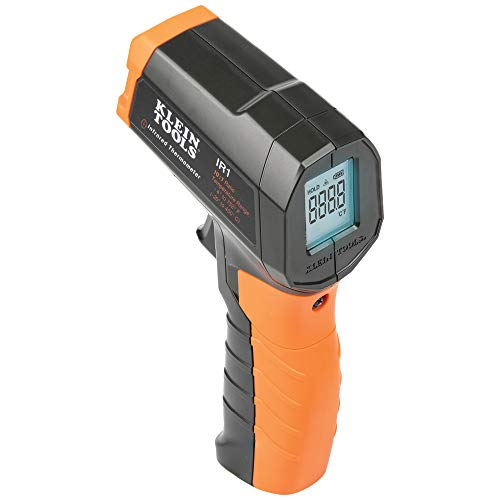
PRECISE TEMPERATURE MEASUREMENT: Optical resolution (distance-to-spot) of 10:1 ensures accurate temperature readings from a distance

【Highly Accurate & Adjusts to Any Surface】Designed with the latest thermopile sensor technology, the infrared laser thermometer gun is accurate to +/-1.5%; Improve this pizza oven thermometer gun measurements by adjusting the emissivity from 0.1–1.0 to match the surface material being measured

Temperature measurement range:-50℃-500℃ (-58℉-932℉)Display resolution: 0.1 ℃ or 0.1 ℉
Environmental and Lifestyle Factors Affecting Readings
While your thermometer’s accuracy depends on proper calibration and technique, environmental conditions and lifestyle factors equally influence whether you’ll obtain reliable forehead temperature readings. You must verify environmental conditions fall between 16–40°C and avoid drafts, direct sunlight, or radiant heat sources that can skew results by several degrees. Sweat influence is particularly significant; moisture on your forehead triggers evaporative cooling, lowering readings substantially. You’ll need a clean, dry surface for accuracy. Headwear effects also matter considerably—hats, headbands, or hair obstruct infrared detection and cause false readings. Finally, acclimatization impact cannot be overlooked; you should allow 10–15 minutes in your measurement environment before testing to minimize errors from sudden temperature exposure shifts.

Non-Contact Technology For Safe & Hygienic Use: With a built-in infrared temperature sensor, the iHealth PT3 thermometer can read a person’s body temperature within 1.18 inches from the center of the forehead without physically touching the person.

HOW TO USE & BATTERY REPLACEMENT: To take a temperature: (1) Place probe at the center of the forehead, (2) Hold the button and slide straight to the hairline, (3) Release and read the temperature on the display. To replace the battery: (1) Open the back cover by pressing on the ridges and sliding the cover downward, (2) Insert a 9V battery with the positive (+) terminal on the right, (3) Ensure the battery is firmly connected and seated properly, (4) Slide the compartment cover back into place until it clicks.
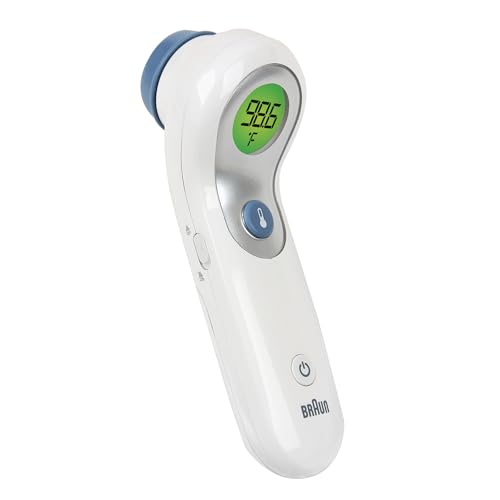
Easy to read: This digital thermometer’s color coded temperature guidance provides results at a glance; green suggests a normal temperature, yellow signifies an elevated temperature, and red indicates a high temperature
Temperature Variations Throughout the Day
Your forehead temperature doesn’t remain static throughout the day—it fluctuates rhythmically as part of your body’s circadian cycle. You’ll typically experience peak forehead temperatures between 9:00 AM and 12:00 PM, averaging around 36.7°C, with the lowest readings occurring around 1:00 PM at approximately 36.2°C. This represents a 0.5°C difference across your diurnal variation.
Understanding these daily temperature fluctuations proves significant for accurate fever assessment. Infrared thermometer accuracy depends partly on measurement timing; your readings can vary up to ±0.5°C due to time-of-day effects alone. Morning forehead temperatures run 0.2 to 0.4°C higher than early afternoon measurements. You should recognize that normal morning readings differ from afternoon baselines, preventing misinterpretation of mild elevations as fever when they simply reflect your body’s natural temperature rhythm.
Individual Differences in Normal Body Temperature
Beyond the predictable rhythm of your daily temperature cycle, normal forehead readings vary greatly among individuals based on age, measurement technique, and environmental conditions. Age impact greatly shapes your baseline temperature—you’ll register lower readings if you’re over 60 compared to younger adults. Children under six months demonstrate wider normal ranges, spanning 95.9°F to 99.5°F orally. Individual variances also stem from metabolic differences; your unique physiology creates distinct baseline temperatures from others’. Environmental factors compound these differences—direct heat exposure, air conditioning, and perspiration all influence your forehead measurements. Measurement location further contributes to individual variances; clinical devices on your forehead typically read 0.5°F to 1°F lower than oral equivalents. Understanding these personal variations helps you establish your own normal range accurately.
Defining Fever: When Forehead Temperature Indicates Illness
A forehead temperature of 100.4°F (38°C) or higher typically indicates fever, though medical organizations like the Infectious Diseases Society of America may use slightly different thresholds—such as 101°F (38.3°C)—depending on clinical context and patient population. You’ll need to contemplate accompanying fever symptoms when evaluating illness severity. Concurrent signs like rash, headache, stiff neck, confusion, or difficulty breathing warrant immediate medical evaluation, as they suggest serious infection. Fever management depends on underlying cause and symptom severity; persistent fever lasting over 72 hours requires diagnostic investigation including blood cultures. Remember that fever severity doesn’t correlate directly with illness severity—some patients appear well despite high temperatures. Immunocompromised and elderly individuals require lower fever thresholds for clinical concern.

✨Swift Results in Just 1 Second: Experience the efficiency of ANMEATE thermometer for adults with its remarkable 1-second read capability. Obtain accurate temperature readings swiftly, providing you with timely and dependable results.
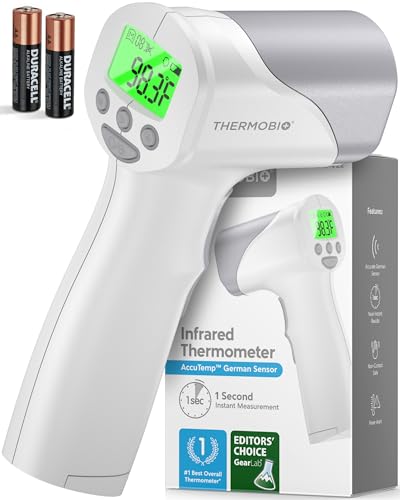
Advanced Technology: Superior performance delivered by the latest smart chip utilizing an optimized algorithm to ensure the 3 ultra sensitive sensors precisely measure your temperature to hygienically deliver accurate results, faster, safer, and more reliably.

UPGRADED DUAL MODE - Our device combines forehead and ear measurements for double accuracy. Forehead mode offers indicative readings in 3 seconds, while ear measurements are medically accurate and instant. Ideal for various settings.
Special Considerations for Children and Elderly Adults
Temperature assessment in pediatric and geriatric populations requires distinct clinical approaches because their physiological responses to infection differ greatly from healthy adults. You’ll find that children’s immune systems may generate higher fevers during mild infections, while elderly sensitivity to temperature changes often masks serious illness with minimal fever elevation.
For infants under three months, you should seek immediate medical evaluation at 100.4°F (38°C) rectal temperature. Children aged three to six months warrant professional consultation exceeding 102°F (38.9°C). Conversely, elderly adults may present life-threatening infections without fever, making behavioral changes and clinical appearance vital diagnostic indicators.
You must recognize that measurement technique notably impacts accuracy. Rectal measurements remain gold standard for infants, while forehead thermometers demonstrate validated reliability under three months. Environmental factors—sunlight, humidity, head coverings—considerably influence non-contact infrared readings across both populations.
Best Practices for Accurate Forehead Temperature Measurement
Recognizing that children and elderly adults require individualized assessment approaches sets the foundation for implementing precise measurement techniques across all populations. You’ll achieve maximum accuracy by maintaining the manufacturer’s recommended 3–5 cm distance and positioning the thermometer perpendicular to the forehead’s center. Your measurement technique must include stabilizing the head to minimize movement and allowing the individual to relax facial muscles throughout the reading. Thermometer maintenance proves equally critical—you should regularly clean the sensor and verify calibration against standard equipment set at ~37°C. Additionally, you’ll need to make certain the forehead is free from sweat, makeup, or debris, and conduct measurements in temperature-stabilized, draft-free environments. Taking multiple readings and averaging results strengthens screening accuracy when individual measurements show variability.

【6 Pieces of 16mm Sensor Cleaning Swabs】 Tailored according to the size of the APS-C frame frame sensor;Smudge-and lintfree, flexible grip rod allows the head to be close to the sensor without harm. The width of swab is 16mm and each swab is vacuum packaged.

Sensor Cleaning Fluid: Screen cleaner can strongly clean stains, uses the power of ultrapure water to clean without leaving streaks or blemishes, safe for all electronics, coated lenses and screen

A century of powerful relief: At Vicks, we believe everyone deserves a touch of care, and our digital thermometer for adults, digital thermometer for kids, and baby thermometer for infants provide quick, accurate results when you need them most