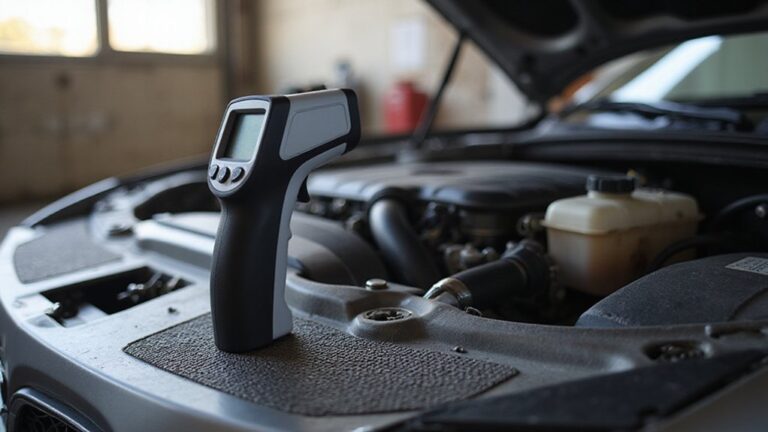
You’ll need an infrared thermometer with ±1°C accuracy and a 12:1 distance-to-spot ratio for precise bearded dragon monitoring. Look for models featuring large backlit LCD screens, min/max tracking, and adjustable emissivity settings. Zoo Med ReptiTemp and ReptiliaCare offer reliable performance with continuous monitoring capabilities. Position your thermometer 2 inches from basking surfaces, avoid measuring through glass, and take readings across multiple enclosure zones. Understanding which features matter most—and how to use them correctly—significantly impacts your dragon’s thermoregulation success.
Types of Infrared Thermometers for Reptile Care
When you’re setting up a bearded dragon enclosure, you’ll encounter several infrared thermometer designs, each offering distinct advantages for monitoring your reptile’s environment. Handheld models provide portable, point-and-click surface readings ideal for checking basking sites and heat pads. Pocket-sized versions suit field work and travel due to their compact weight. Targeting lasers enhance thermometer accuracy by pinpointing specific spots in low-light conditions or hard-to-reach areas. Continuous monitoring functions track temperature changes over time, while min/max capabilities record temperature gradients across your enclosure. These different applications allow you to assess basking site temperatures, substrate safety, and ambient conditions systematically. Additionally, infrared thermometers are widely employed in industrial settings for precise temperature monitoring, emphasizing their versatility and importance in various fields. Proper use of infrared thermometers is essential for reliable temperature measurement, ensuring accurate readings in your bearded dragon’s habitat. Selecting the right type depends on your monitoring needs and enclosure complexity.

Precision Health Guardian: Your reptile pets are very sensitive to temperature and humidity, and small changes can affect their comfort and even their health. This humidity thermometer utilizes a built-in high-precision measurement chip that monitors the environment with 0.9°F accuracy, ensuring you are always aware of the actual conditions in your animal's tank. It's not just a matter of caring, it's a consideration for your pet's long-term health.

DIGITAL INFRARED THERMOMETER: The 12:1 D:S Ratio laser infrared thermometer temperature gun with a 1 point laser provides speed and accuracy in measuring external surface temperatures for Terrarium or Aquarium use

Reptile Necessary: Meet the need of Humidity and Temperature measuring for monitoring reptile's living conditions and health. Easily check your pet's living environment. When there are abnormalities, you can timely discovery through reptile thermometer.
Essential Features to Look for in a Bearded Dragon Thermometer
Now that you’ve identified which thermometer type suits your monitoring needs, you’ll want to evaluate specific performance characteristics that determine whether a device will reliably track your bearded dragon’s environment. Temperature accuracy within ±1°C is crucial for precise basking spot monitoring. You’ll benefit from a measurement range covering 0°C to 100°C, encompassing both ambient and basking temperatures. Look for instantaneous readings delivered via large, backlit LCD screens with laser targeting for exact spot identification. A distance-to-spot ratio of at least 12:1 guarantees accurate targeting of small areas. Durable, water-resistant construction withstands humid enclosures, while max/min recording tracks temperature fluctuations. User reviews often highlight reliability and build quality. Prioritize devices with factory calibration certificates and adjustable emissivity settings for surface-specific accuracy.

Temperature measurement range:-50℃-500℃ (-58℉-932℉)Display resolution: 0.1 ℃ or 0.1 ℉

𝐕𝐞𝐫𝐬𝐚𝐭𝐢𝐥𝐞 𝐓𝐨𝐨𝐥𝐬: Infrared technology allows you to measure various objects at home and outdoors; Use it for 𝒎𝒆𝒂𝒕, 𝑫𝑰𝒀 𝒄𝒂𝒏𝒅𝒚, 𝒐𝒗𝒆𝒏𝒔, 𝒈𝒓𝒊𝒍𝒍𝒊𝒏𝒈, 𝒇𝒐𝒐𝒅, 𝒄𝒐𝒐𝒌𝒊𝒏𝒈, 𝒂𝒖𝒕𝒐𝒎𝒐𝒕𝒊𝒗𝒆 𝒖𝒔𝒆, 𝑨/𝑪, 𝒓𝒆𝒇𝒓𝒊𝒈𝒆𝒓𝒂𝒕𝒐𝒓𝒔, etc.

*Temperature range and Accuracy:Measuring surface temperature range is - 58 °F~1022 °F (- 50 °C~550 °C);Target distance of the laser temperature gun is 12:1,Target can be measured at a longer distance.Adjustable emissivity to suit different kinds of objects.
Optimal Temperature Ranges for Bearded Dragon Habitats
Since bearded dragons are ectothermic reptiles that rely on external heat sources to regulate their body temperature, you’ll need to establish precise thermal gradients throughout your enclosure to support their physiological functions. Your basking area should reach 40-42°C (104-107°F) for ideal digestion and activity, while the cool end maintains 22-25°C (71-77°F). This gradient enables thermoregulation essential for metabolic processes.
For habitat enhancement, nighttime temperatures should drop to 70-75°F (21-24°C), mimicking natural circadian rhythms. Temperature monitoring becomes critical for juveniles, requiring 95-105°F (35-41°C) basking spots and 80-90°F (27-32°C) cool zones to support developmental thermoregulation.
Maintaining proper humidity levels between 30-40% complements temperature management, supporting respiratory health and efficient water retention. Coordinate your heating equipment placement overhead at one enclosure end, positioning UVB lighting alongside heat sources for thorough habitat requirements.
Top-Rated Infrared Thermometer Models and Brands
To establish and maintain the precise thermal gradients outlined above, you’ll need reliable measurement tools that deliver accurate surface temperature data without disturbing your bearded dragon. Popular brands like Zoo Med and ReptiliaCare dominate the market. The Zoo Med ReptiTemp offers Min-Max tracking and continuous monitoring capabilities in a compact 1 x 4 x 5.625 inch design. ReptiliaCare’s model features an 8:1 distance-spot ratio with a wider temperature range (-26 to 536°F) and backlit LCD display, though user reviews indicate accuracy concerns despite its 4.5-star Amazon rating. Professional-grade models with adjustable emissivity settings outperform fixed-setting alternatives. When evaluating options, prioritize accuracy ratings and feature functionality rather than price alone to guarantee reliable thermal environment assessment.

* MULTI-FUNCTION: A handy, consistent and versatile temperature gun for instant temp readings in performing auto maintenance, cooking, barbecuing, industrial,measuring temperature of household appliances, doing home repairs etc.our infrared temperature gun does it all!

Precision Health Guardian: Your reptile pets are very sensitive to temperature and humidity, and small changes can affect their comfort and even their health. This humidity thermometer utilizes a built-in high-precision measurement chip that monitors the environment with 0.9°F accuracy, ensuring you are always aware of the actual conditions in your animal's tank. It's not just a matter of caring, it's a consideration for your pet's long-term health.

Reptile Necessary: Meet the need of Humidity And Temperature measuring for monitoring reptile's living conditions and health. Easily check your pet's living environment. When there are abnormalities, you can timely discovery through reptile thermometer.
Proper Usage, Maintenance, and Safety Guidelines
While infrared thermometers are invaluable tools for maintaining proper thermal environments, they’ll only deliver reliable data when you’re using them correctly. Position your thermometer 2 inches from the basking surface, aiming directly at the substrate rather than through glass, which causes reflection errors. For infrared thermometer accuracy, keep the lens clean with a soft cloth and store the device in dry conditions.
Your temperature measurement techniques should include checking multiple enclosure zones—basking area, warm end, cool end, and middle—to establish proper gradients. Never direct the laser at your dragon’s eyes or other animals to prevent injury. Replace batteries promptly and avoid dropping the device. Always take readings without disturbing your dragon, minimizing stress and bite risk. Combine infrared measurements with digital probe thermometers for thorough ambient temperature assessment.