

You’ll find that infrared thermometers, despite FDA clearance and ±0.3°C accuracy claims, miss adult fevers up to 88% of the time. Contactless forehead models show particularly low sensitivity (0–13%), while tympanic devices perform better at 83–88%. Environmental factors—ambient temperature fluctuations, humidity, and positioning—significantly compromise readings outside controlled settings. Accuracy degrades further during fever, where core temperature discrepancies widen. Confirming elevated readings with oral electronic thermometers remains essential for reliable diagnosis, though understanding the specific factors undermining performance reveals why clinical protocols vary substantially.
Laboratory Standards and Regulatory Requirements
To guarantee infrared thermometers deliver reliable clinical measurements, they’re subject to rigorous laboratory standards and regulatory oversight that establish performance benchmarks across device types and use cases. The FDA classifies non-contact infrared thermometers as Class II medical devices requiring 510(k) premarket clearance before you can market them. ASTM E1965 and ISO 80601-2-56 mandate that your laboratory calibration and accuracy testing meet strict specifications—typically within ±0.3°C relative to blackbody sources, with ear canal thermometers requiring even tighter ±0.2°C tolerances. These standards demand traceability to national institutions like NIST and international frameworks such as ISO 17025. Furthermore, infrared thermometers are versatile tools that support various applications across multiple fields ensuring their reliability in clinical settings. Your devices undergo controlled environmental testing to ascertain performance across varying temperature and humidity conditions, establishing the foundation for clinical reliability. Additionally, regular thermometer calibration checks are essential for maintaining measurement accuracy in clinical settings.

【Highly Accurate & Adjusts to Any Surface】Designed with the latest thermopile sensor technology, the infrared laser thermometer gun is accurate to +/-1.5%; Improve this pizza oven thermometer gun measurements by adjusting the emissivity from 0.1–1.0 to match the surface material being measured

Get reliable, precise temperature readings in just 1 second with this no-touch forehead thermometer. Equipped with a high-sensitivity infrared sensor, it delivers consistent results for babies, children, and adults, giving you peace of mind whenever you need to check for fever. The thermometer supports both ℉ and ℃ switching, meeting all your daily temperature measurement needs at home.

FDA 510(K) CLEARED, MEDICAL-GRADE ACCURACY: The SimpliCare FC-IR206 is FDA 510(k) cleared and reads to +/-0.4F, clinical-grade precision you can trust for tracking a fever at home, verified for infants, kids, and adults alike.
Clinical Accuracy Compared to Core Body Temperature
While laboratory standards establish theoretical performance benchmarks, infrared thermometers’ clinical accuracy—when compared directly against core body temperature measured through invasive methods like the SpotOn system—reveals substantial limitations. You’ll find wide limits of agreement reaching –0.58 to 0.97°C, far exceeding acceptable clinical margins of ±0.2°C. Core temperature discrepancies increase markedly as actual temperatures rise, causing systematic underestimation during fever. Research demonstrates that 48% to 88% of individual measurements fall outside manufacturer-stated accuracy ranges. Anatomical site selection critically influences performance; forehead readings outperform temple measurements, though neither reliably captures true core temperature. These infrared accuracy challenges persist across device models, fundamentally undermining their clinical utility for precise temperature assessment in adults requiring definitive fever detection.
Sensitivity and Specificity Across Infrared Thermometer Types
Because infrared thermometers vary considerably in their ability to detect fever, understanding their diagnostic performance characteristics becomes essential for clinical decision-making. You’ll find that temporal artery thermometers demonstrate superior sensitivity at 88%, outperforming both tympanic and contactless alternatives. Tympanic thermometers offer moderate sensitivity (83–88%) and specificity (86–88%), making them reasonably reliable for screening. Conversely, contactless forehead thermometers prove problematic, with sensitivity as low as 0–13%, though they maintain high specificity. Critically, model-to-model variability presents a significant challenge—sensitivity for detecting temperatures above 38°C ranges from 0 to 0.69 across different devices. This variability necessitates careful device selection and recognition that individual model accuracy often falls outside acceptable clinical limits, potentially compromising standalone fever screening reliability.
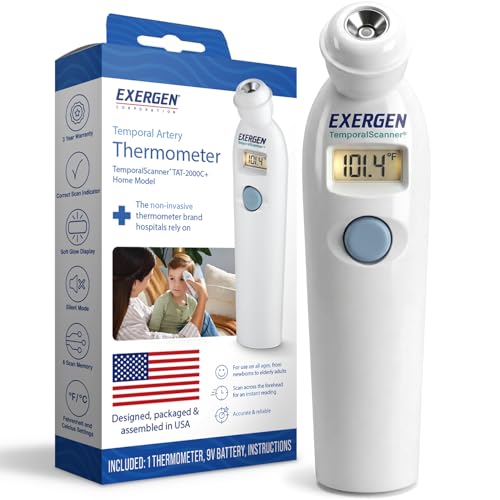
Fast, Accurate & Clinically Proven: Patented temporal artery technology provides quick, precise, non-invasive forehead readings that closely reflect core body temperature — more accurate than standard thermometers.

HOW TO USE & BATTERY REPLACEMENT: To take a temperature: (1) Place probe at the center of the forehead, (2) Hold the button and slide straight to the hairline, (3) Release and read the temperature on the display. To replace the battery: (1) Open the back cover by pressing on the ridges and sliding the cover downward, (2) Insert a 9V battery with the positive (+) terminal on the right, (3) Ensure the battery is firmly connected and seated properly, (4) Slide the compartment cover back into place until it clicks.

Exergen Temporal Thermometer
Why Contactless Forehead Thermometers Underperform
Despite their convenience and widespread adoption, contactless forehead thermometers suffer from fundamental design and operational limitations that compromise their clinical reliability. You’ll encounter sensor variability across manufacturers, with calibration inconsistencies affecting measurement accuracy. The devices measure surface temperature rather than core body temperature, creating inherent discrepancies that you cannot eliminate through technique alone. Infrared thermometers, while effective for measuring surface temperature, are not designed for accurately reflecting deeper body temperatures.
Your measurement inconsistency stems from multiple sources: improper positioning, inadequate forehead preparation, and environmental interference. You must maintain precise distance and angle per manufacturer specifications—deviations introduce significant errors. Environmental factors like air conditioning, heating, and ambient temperature fluctuations alter skin surface readings independent of actual body temperature.
Additionally, you face challenges from individual physiological differences, including skin thickness and blood flow variations. Without rigorous calibration maintenance and proper technique, these devices deliver unreliable results that don’t meet clinical standards for fever detection or temperature monitoring. Furthermore, these thermometers measure surface temperature and cannot assess deeper body temperature, which limits their effectiveness in accurate health assessments.

✨Swift Results in Just 1 Second: Experience the efficiency of ANMEATE thermometer for adults with its remarkable 1-second read capability. Obtain accurate temperature readings swiftly, providing you with timely and dependable results.

No-Contact Thermometer: GoodBaby touchless thermometer provides contactless accurate temperature reading that helps you avoid cross infections. No need to clean the thermometer after every use

★【MULTI-MODE THERMOMETER】:The Berrcom forehead thermometer is designed for all ages, adults, infants and elders. It not only supports forehead function, but is able to take room/object temperature. ℃ and ℉ are easily switchable.
Environmental Factors That Compromise Readings
Your infrared thermometer’s accuracy deteriorates considerably when you operate it outside its calibration environment, as ambient temperature directly alters the device’s ability to detect and measure infrared radiation accurately. Temperature fluctuations between 18-32°C introduce systematic errors that compromise reliability. Humidity effects similarly degrade performance; relative humidity ranging from 15% to 85% measurably influences sensor output through water vapor attenuation of infrared signals. Operating beyond manufacturer humidity specifications substantially reduces precision. Additionally, atmospheric interference accumulates during extended measurement sessions in uncontrolled environments. Dust particles, water mist, and aerosol particles scatter and absorb infrared radiation before reaching your sensor. For example, measuring distance variations and reflective surface complications compound these environmental challenges, requiring you to maintain strict environmental control for dependable temperature readings. To obtain accurate results, you should ensure proper distance-to-spot ratio by measuring as close as safely possible to the target.
User Technique and Proper Measurement Protocols
While environmental controls establish the baseline conditions for reliable infrared thermometry, operator technique and measurement standardization ultimately determine whether you’ll achieve clinically acceptable readings. Proper user technique requires you to maintain perpendicular device positioning at 3–5 cm from the central forehead, avoiding direct contact with skin. You should stand to the side rather than facing your subject directly. Standardized measurement protocols demand that you use the same operator and thermometer model throughout repeated measurements, spacing trials approximately 10 minutes apart. Positioning the infrared detector at the forehead’s center consistently narrows limits of agreement with reference standards. By adhering strictly to manufacturer guidelines and maintaining rigorous technique, you’ll substantially improve measurement accuracy and clinical reliability. Additionally, ensuring the thermometer has acclimated to the environment before use is critical for precise temperature readings. This is important because the thermometer compensates for ambient temperature to provide accurate results.
Device-Specific Limitations and Model Variability
Even with meticulous technique and controlled environments, you’ll encounter significant accuracy variations across infrared thermometer models—a critical limitation that fundamentally undermines their reliability for clinical screening. Model discrepancies reveal dramatic performance disparities: sensitivity for detecting temperatures above 38°C ranges from 0 to 0.69 depending on which device you use. Model C maintains the lowest clinical bias yet still produces 50% of readings outside manufacturer specifications, while Model E generates 88% non-compliant measurements. These accuracy challenges extend beyond individual variability—they reflect inherent device-specific limitations. Distance requirements, sensor specifications, and calibration differences create compounding errors. You cannot assume consistent performance across models, making standardization impossible for reliable fever detection protocols. Notably, these reliability issues also parallel concerns in veterinary practice, where infrared thermometers for dogs are often misleadingly inaccurate compared to traditional methods.

FAST, RELIABLE RESULTS: 1-second measurement at the forehead. Meets ASTM E1965-98 standards for accuracy and is backed by a 2-year warranty.
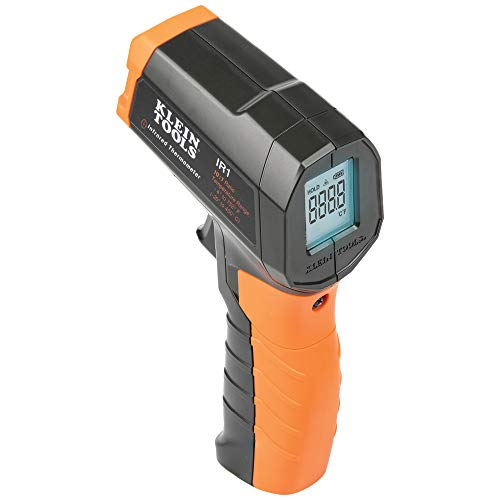
PRECISE TEMPERATURE MEASUREMENT: Optical resolution (distance-to-spot) of 10:1 ensures accurate temperature readings from a distance

𝐕𝐞𝐫𝐬𝐚𝐭𝐢𝐥𝐞 𝐓𝐨𝐨𝐥𝐬: Infrared technology allows you to measure various objects at home and outdoors; Use it for 𝒎𝒆𝒂𝒕, 𝑫𝑰𝒀 𝒄𝒂𝒏𝒅𝒚, 𝒐𝒗𝒆𝒏𝒔, 𝒈𝒓𝒊𝒍𝒍𝒊𝒏𝒈, 𝒇𝒐𝒐𝒅, 𝒄𝒐𝒐𝒌𝒊𝒏𝒈, 𝒂𝒖𝒕𝒐𝒎𝒐𝒕𝒊𝒗𝒆 𝒖𝒔𝒆, 𝑨/𝑪, 𝒓𝒆𝒇𝒓𝒊𝒈𝒆𝒓𝒂𝒕𝒐𝒓𝒔, etc.
Advantages of Non-Contact Temperature Screening
Despite their documented accuracy limitations, non-contact infrared thermometers (NCITs) offer five distinct operational advantages that have driven their widespread adoption in clinical and public health screening scenarios. You’ll appreciate how NCITs minimize cross-contamination risk through eliminating physical contact, reducing infectious agent transmission in high-traffic environments like airports and clinics. The devices deliver rapid temperature measurements within seconds, enhancing screening efficiency for large populations in emergency departments and mass gatherings. Their intuitive point-and-shoot design requires minimal training, allowing non-medical personnel to operate them effectively. NCITs eliminate disinfection requirements between patients, reducing consumable costs and maintenance burdens. Finally, you can deploy these versatile instruments across diverse settings—hospitals, workplaces, schools—supporting mobile screening initiatives while maintaining user comfort and operational efficiency throughout prolonged screening sessions. However, it’s important to note that NCITs primarily measure surface temperatures rather than internal body temperatures, which may affect their accuracy in some contexts.

Non-contact Thermometer: According to the infrared technology, you can measure body temperature without touching the ear or the forehead, prevent cross-infection between multiple people. Measurement Distance: 2-3.15 inch.
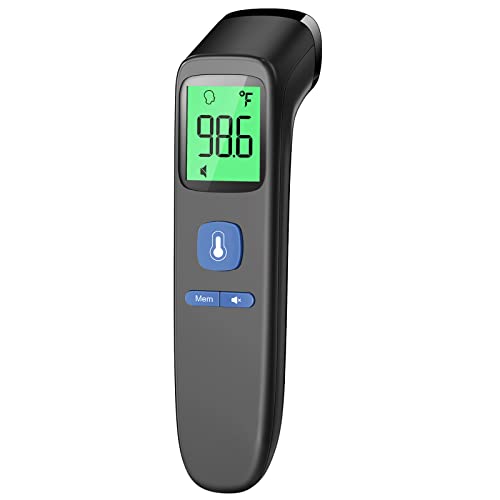
Reliable & Accurate: Goodbaby Forehead Thermometer has been clinically tested and found to be a fast and absolutely reliable gadget to use. It is ideal for forehead readings.

【HIGH ACCURACY】-Non-contact laser measurement & K probe contact measurement with13 Points Laser Guidance and adjustable emissivity (0.1-1.0) for more accurate measurement.French HTU20 temperature sensor and laser head are used to display the ambient temperature/humidity, dew point,spoilage temperature, surface and interior temperature of the object at the same time
Best Practices for Reliable Fever Detection in Adults
Maximizing the operational advantages of non-contact infrared thermometers requires you to implement systematic best practices that substantially improve their diagnostic reliability in adult fever detection. You’ll establish performance benchmarks by regularly calibrating devices against reference thermometers and black body sources. Your monitoring strategies must include acclimating subjects for 15 minutes in climate-controlled environments before measurement, ensuring clean, dry foreheads, and positioning the device 3–5 cm perpendicularly from the skin surface. You’ll confirm elevated readings with oral electronic thermometers rather than relying solely on contactless devices. Train staff thoroughly on manufacturer protocols and document measurement consistency periodically. You’ll recognize that these instruments serve as preliminary screening tools, not definitive diagnostic devices, reducing false negatives through validated clinical procedures. Additionally, maintaining an understanding of emissivity values can enhance the effectiveness of infrared thermometers in various diagnostic contexts.


