You’ll measure your catalytic converter’s efficiency by comparing inlet and outlet temperatures using an infrared thermometer. First, warm your engine to 600–800°F, then aim perpendicular at the upstream and downstream pipe sections. A healthy converter shows a 50–100°F temperature differential during operation. Readings below 50°F suggest poor catalytic performance, while no temperature rise indicates a blocked or failed unit. The specifics of proper technique and interpretation reveal critical diagnostic insights.
Selecting the Right Infrared Thermometer for Catalytic Converter Testing
How do you guarantee your temperature readings won’t mislead you during catalytic converter diagnostics? You’ll need an infrared thermometer with adjustable emissivity settings to compensate for the converter’s reflective metal surface. Select a device covering at least 870°C (1600°F) to capture peak exhaust temperatures.
Prioritize fast response time—this assures you’re capturing accurate readings as temperatures fluctuate during testing. Choose a thermometer with dual laser targeting for precise aiming at inlet and outlet sections. Look for models offering temperature scanning functions like minimum, maximum, and average measurements.
Quality matters more than price. A poorly made unit delivers unreliable diagnostics. Verify the device provides adequate distance-to-spot ratio for safe, contamination-free measurements. Confirm the digital display is clear and readable in typical garage lighting conditions.

【Highly Accurate & Adjusts to Any Surface】Designed with the latest thermopile sensor technology, the infrared laser thermometer gun is accurate to +/-1.5%; Improve this pizza oven thermometer gun measurements by adjusting the emissivity from 0.1–1.0 to match the surface material being measured

𝐕𝐞𝐫𝐬𝐚𝐭𝐢𝐥𝐞 𝐓𝐨𝐨𝐥𝐬: Infrared technology allows you to measure various objects at home and outdoors; Use it for 𝒎𝒆𝒂𝒕, 𝑫𝑰𝒀 𝒄𝒂𝒏𝒅𝒚, 𝒐𝒗𝒆𝒏𝒔, 𝒈𝒓𝒊𝒍𝒍𝒊𝒏𝒈, 𝒇𝒐𝒐𝒅, 𝒄𝒐𝒐𝒌𝒊𝒏𝒈, 𝒂𝒖𝒕𝒐𝒎𝒐𝒕𝒊𝒗𝒆 𝒖𝒔𝒆, 𝑨/𝑪, 𝒓𝒆𝒇𝒓𝒊𝒈𝒆𝒓𝒂𝒕𝒐𝒓𝒔, etc.

►【HIGH ACCURACY】Combining the latest temperature sensor technology and advanced Fresnel lens, this instrument reads values of high accuracy up to ±2% in only 0.5s thanks to adjustable emissivity. The distance to spot ratio is 12:1, which means you can measure the target at a longer distance.
Preparing Your Vehicle for Accurate Temperature Measurements
Selecting the right infrared thermometer sets the foundation for accurate diagnostics, but your equipment can only deliver reliable data if you’ve properly prepared the vehicle itself. Start by running your engine at idle or low speed until the catalytic converter reaches operating temperature—typically 600°F to 800°F. Use engine diagnostics or temperature sensors to confirm the converter’s warming status. Before measuring, verify your oxygen sensors and exhaust components upstream of the converter function properly, and inspect for leaks that’d skew readings. Clear any stored engine codes affecting engine management. Position your vehicle on a flat, stable surface with the parking brake engaged. Allow 1–2 minutes after stabilizing engine RPM for thermal equilibrium before recording data. Avoid rapid throttle changes immediately before measurements to prevent temperature fluctuations.
Locating and Identifying Measurement Points on the Catalytic Converter
Once you’ve prepared your vehicle and confirmed the catalytic converter’s operating temperature, you’ll need to locate the precise measurement points that’ll yield reliable diagnostic data. Identify the converter’s inlet at the upstream end, adjacent to the exhaust manifold—this measurement location captures incoming exhaust temperatures. Locate the outlet at the downstream end, closer to the muffler section. Use weld rings or joints as visual indicators marking these exact points. Position your infrared thermometer perpendicular to the pipe surface, maintaining consistent distance and aiming technique. Target the welded pipe sections immediately before and after the converter shell rather than the bulged converter body itself. These measurement locations guarantee accurate differential temperature readings reflecting catalytic activity and converter efficiency.
Taking Precise Inlet and Outlet Temperature Readings
Accurate temperature differential is your diagnostic foundation, and achieving it requires meticulous attention to instrument calibration and measurement technique. You’ll start by calibrating your infrared thermometer according to manufacturer specifications, adjusting emissivity settings to match your converter’s surface properties. Confirm measurement consistency by positioning your thermometer at identical distances and angles for both inlet and outlet readings. Measure at the same marked spot each time, avoiding welds or joints where heat dissipates irregularly. Take multiple readings in succession while your engine operates at stable RPM under consistent load. Record temperatures immediately, documenting environmental conditions, distance, and angle. This systematic approach minimizes error margins and establishes reliable baseline data for accurate converter diagnostics.

𝐖𝐢𝐝𝐞 𝐓𝐞𝐦𝐩𝐞𝐫𝐚𝐭𝐮𝐫𝐞 𝐑𝐚𝐧𝐠𝐞: Measure a temperature range from -58°–1130°𝙁 / -50°–610°𝘾 𝙖𝙣𝙙 𝙜𝙚𝙩 𝙮𝙤𝙪𝙧 𝙧𝙚𝙨𝙪𝙡𝙩 𝙞𝙣 0.5 𝙨𝙚𝙘𝙤𝙣𝙙𝙨; The display will also show the max temperature of the surface you’re measuring. Perfect heat gun for measuring.

Temperature measurement range:-50℃-500℃ (-58℉-932℉)Display resolution: 0.1 ℃ or 0.1 ℉
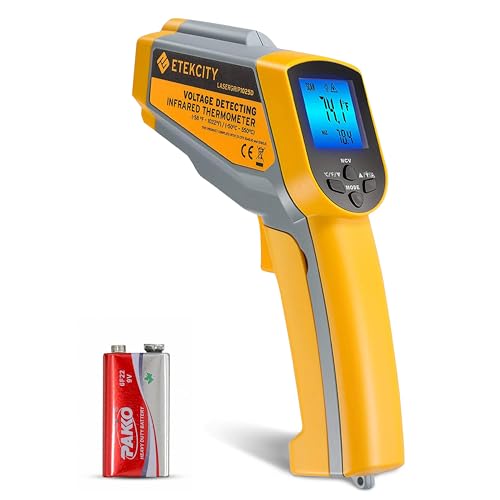
NOT FOR HUMAN: Temperature readings from this device are inanimate objects. The measured temperature for humans or animals will not be correct, 9V battery included. Class 2 laser, optical power 0.3-0.49Mw
Interpreting Temperature Differential Results and Performance Standards
With your inlet and outlet temperature readings documented, you’ll now compare the differential against established performance benchmarks to assess your converter’s functional status.
A healthy catalytic converter demonstrates a temperature differential of 50–100°F between inlet and outlet during normal operation. This range indicates proper converter efficiency and adequate catalyst activity. Differentials below 50°F suggest low efficiency or insufficient catalytic performance. Conversely, differentials exceeding 100°F may indicate excessive converter loading or internal damage.
No temperature rise or a drop across the converter signals a blocked or failed unit. Additionally, monitor for abnormal patterns: sustained temperatures above 1,200°F risk internal damage, while rapid spikes suggest engine misfires or excessive unburned fuel. Steady, consistent temperature rises without sudden fluctuations confirm ideal converter performance and reliability.

【Professional Exhaust Diagnostic Tool】Accurately measures exhaust back pressure to help identify clogged catalytic converters, DPF, or mufflers. Ideal for diagnosing engine performance issues such as power loss, poor acceleration, and overheating in gasoline and diesel vehicles.

PREMIUM ABS AND METAL MATERIAL: Our water temp gauge is made of ABS and stainless steel, which is lightweight, hard-wearing, non-deformable, unfading, and has a long service life

[Quality Material] Our water temp gauge is made of high-quality ABS material, which is light weight, fast fading, high temperature resistance, wear resistance, corrosion resistance, and can be used for a long time.
Supplementary Diagnostic Methods and Troubleshooting Failed Tests
When temperature differential testing yields inconclusive results or you’ve identified a potential converter fault, you’ll want to employ additional diagnostic methods to pinpoint the exact problem and rule out related system failures. Pressure differential testing measures exhaust resistance before and after the converter—significant pressure increases indicate internal clogging. Oxygen sensor signal analysis using a scan tool reveals whether downstream signals remain steady or mirror upstream fluctuations, distinguishing converter inefficiency from sensor failure. Vacuum gauge testing during rapid deceleration demonstrates exhaust flow restriction. Visual inspection checks for discoloration, physical damage, and rattling sounds indicating broken catalyst material. Live OBDII data retrieves relevant DTCs like P0420 and P0430, confirming converter issues while eliminating alternative causes through freeze frame analysis.