You’ll insert your thermometer’s probe into the thickest section of the steak, positioning it from the side while avoiding bone and fat. This thermal center gives you the most accurate reading. Account for carryover cooking by pulling your steak 3–5 degrees below your target doneness—10 degrees for high-heat grilling. Let it rest 5 minutes per inch of thickness so juices redistribute. Master these techniques, and you’ll reveal the secrets to consistently perfect steaks.
Selecting the Right Thermometer
Before you’ll want to choose a thermometer that matches your cooking style and budget. You’ll find several types available: instant-read models deliver readings in 2–5 seconds, while leave-in probe thermometers remain inserted during cooking for continuous monitoring. Wireless thermometers transmit data to your smartphone, offering convenience for multitasking.
One should also consider the flexibility in cooking methods when selecting a thermometer that works best for your needs.
Thermometer accuracy is paramount when achieving your desired doneness. Digital thermometers typically provide ±0.9°F accuracy, considerably outperforming traditional dial models. Ascertain your chosen thermometer covers standard steak temperatures (32°F to 212°F) and features a probe length reaching thick cuts’ centers.
Consider essential thermometer features like backlit displays for low-light grilling, waterproof construction for easy cleaning, and auto-off functions preserving battery life. Entry-level options start around $10–$20, while premium brands like ThermoWorks offer superior durability and reliability at $50 or higher. Additionally, a quality thermometer can enhance your cooking experience by ensuring perfectly cooked meals, similar to how a Le Creuset Dutch Oven retains moisture and infuses flavors in dishes like chicken.

【8X Faster + 4X More Precise】: Upgraded with an industrial-leading professional thermocouple sensor, Themomonster meat thermometer digital with NIST certified ±0.5℉ precision provides you the accurate temperature of your food in just 0.5 Seconds.

Instant Read Meat Thermometer | Our instant read thermometer features a temperature probe and advanced, highly accurate technology with a 1-2 second response time. Our instant read food thermometer comes pre-calibrated with instructions and a meat temperature chart, plus a recalibration feature if needed.

【Fast & Accurate】Our meat thermometer digital delivers accurate readings within ±1°F in just 1–2 seconds, with a wide temperature range of -58°F to 572°F (-50°C to 300°C). No more waiting over the heat - know your food's exact temperature instantly.
Finding the Thermal Center
The thermal center—the coolest spot within your steak—is where you’ll find the most accurate temperature reading, since it’s the last area to reach your target doneness. Temperature gradients in steaks run wider than their thickness, making the center your most reliable measurement point.
Understand that the thermal center isn’t always geometrically central; it shifts based on your steak’s thickness and shape. Insert your probe horizontally from the side into the thickest section, positioning the tip at the absolute center while avoiding bone, fat, and gristle.
Use this thermal center technique: insert the probe past your estimated center, then slowly withdraw it until you locate the coolest temperature reading. That’s your thermal center. Moving the probe in either direction will show rising temperatures due to heat gradients, confirming you’ve found the accurate readings you need. Always ensure you are using an oven-safe thermometer if you plan to leave it inside the meat while cooking. It is important to verify this specific thermometer’s label that confirms its oven-safe status, to avoid any damage during cooking.
Pull Temperature and Carryover Cooking
Once you’ve identified your steak’s thermal center, you’ll need to master pull temperature—the internal reading at which you should remove your steak from heat before it reaches your final target doneness. Your steak will continue cooking after removal due to carryover cooking, typically rising 3 to 5 degrees Fahrenheit during the resting period. Understanding temperature differentials is vital: pull guidelines vary based on your cooking method. High-heat grilling at 450–550°F creates larger differentials, requiring you to pull steaks 10 degrees below target. Lower-temperature cooking produces minimal carryover, so you’ll pull closer to your final temperature. For medium-rare, pull at 115–120°F to reach 130–135°F. It is important to remember that meat continues cooking slightly after removal from heat due to carryover cooking. In addition, dedicated grill thermometers can help ensure you are aware of the ambient cooking temperature, aiding in better pull temperature decisions. Rest your steak at least 10 minutes to allow heat equalization and juice reabsorption throughout the meat. Regular temperature checks with an instant-read meat thermometer do not result in juice loss, so frequent probing is encouraged to achieve your desired steak temperature.
Doneness Temperature Guide
Mastering doneness temperatures is fundamental to cooking steaks precisely—you’ll need to understand both your target final temperature and the removal temperature that accounts for carryover cooking. Each doneness level defines distinct textural and flavor characteristics. Rare steaks reach 120–125°F with a cool red center and soft texture, while medium rare hits 130–135°F for ideal marbling and juiciness. Medium ranges from 140–145°F with a pink center and firmer bite. Medium well achieves 150–155°F with minimal pink, and well done exceeds 160°F entirely. Additionally, achieving perfect steak doneness relies on understanding how to create steam in cooking processes, ensuring even heat distribution.
Your cooking techniques must align with these targets. Remove rare at approximately 118–120°F, medium rare at 125–130°F, and medium at 136–140°F. This strategic removal accounts for residual heat that continues cooking during your resting period, ensuring you reach your desired final temperature without overshooting doneness. Additionally, understanding how to use sous vide principles can enhance your ability to achieve perfect steak doneness consistently.
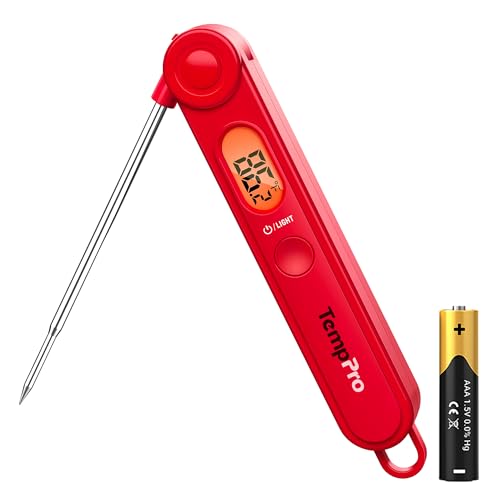
【Easy to Use】Easily release the meat probe at the push of a button, and control the backlight or power with another button. With TempPro, cooking becomes a seamless, stress-free experience

Completely Waterproof: IPX6 waterproof rating means you can wash this cooking thermometer under running water without fear. This food thermometer for cooking ensures cleanup is ultra-fast

【Fast & Accurate】Our meat thermometer digital delivers accurate readings within ±1°F in just 1–2 seconds, with a wide temperature range of -58°F to 572°F (-50°C to 300°C). No more waiting over the heat - know your food's exact temperature instantly.
Resting the Steak
After you’ve removed your steak from heat, you’ve only completed half the cooking process—the resting phase is equally critical to achieving perfect results. During resting, the meat’s muscle fibers relax while juices redistribute evenly throughout, guaranteeing moisture retention and peak flavor. Vacuum sealing(removing oxygen) can enhance the preservation of cooked meats for later enjoyment. The resting technique shares similarities with how you should avoid soaking cast iron skillets after cooking, emphasizing the importance of moisture control in both cooking and care.
Expect temperature changes during rest: thin steaks rise 3–6°F internally, while larger cuts can increase 10–15°F. This carryover cooking continues naturally without additional heat. Cooked meat should not sit out for more than two hours to avoid bacteria growth.
For resting techniques, place your steak on a warm plate and tent it loosely with foil—avoid sealing tightly, which causes steaming. Allow air circulation around the meat without cutting or piercing it.
Time your rest accordingly: five minutes per inch of thickness provides best results. Thin cuts require 5–7 minutes minimum; thick cuts need 10–20 minutes. This investment guarantees a perfectly textured, juicy steak.