

You’ll need to cook your chicken to 165°F to instantly eliminate dangerous pathogens like *Salmonella* and *Campylobacter*. This USDA and CDC standard applies to all chicken cuts and cooking methods. Insert your meat thermometer into the thickest part of the meat, avoiding bone and skin, for an accurate reading. At this temperature, harmful bacteria die within just 15 seconds. Understanding the full temperature-time relationship and carryover cooking effects will help you achieve both safety and ideal flavor.
Why 165°F Is the Gold Standard for Chicken Safety
When you cook chicken to 165°F, you’re hitting the temperature that instantly destroys the pathogens—*Salmonella*, *Campylobacter*, and others—that cause roughly 1 million foodborne illnesses annually in the United States. This safety guidelines benchmark, established by the USDA and CDC, eliminates guesswork from chicken cooking. Unlike lower temperatures that require extended hold times, 165°F kills bacteria instantly, making it the most reliable standard regardless of cooking method or chicken cut. The USDA’s National Advisory Committee on Microbiological Criteria for Foods developed this threshold specifically because *Salmonella* is the most heat-resistant common poultry pathogen. By targeting this single, universal temperature, you guarantee pathogen destruction while simplifying food safety across all chicken preparations. Additionally, it’s important to use a meat thermometer correctly by inserting it into the thickest part of the meat to ensure accurate readings, as this ensures proper internal temperature readings. Remember to calibrate your thermometer by testing it in boiling water to verify its accuracy, ensuring that your cooking methods align with safe food handling practices.

【Fast & Accurate】Our meat thermometer digital delivers accurate readings within ±1°F in just 1–2 seconds, with a wide temperature range of -58°F to 572°F (-50°C to 300°C). No more waiting over the heat - know your food's exact temperature instantly.

Instant Read Meat Thermometer | Our instant read thermometer features a temperature probe and advanced, highly accurate technology with a 1-2 second response time. Our instant read food thermometer comes pre-calibrated with instructions and a meat temperature chart, plus a recalibration feature if needed.

Fast and Accurate Reading: Kitchen thermometer for cooking features a 1 second readout speed and high accuracy of +/-0.9 degrees Fahrenheit, ensuring you receive the most delicious results every time
Understanding Foodborne Bacteria and Health Risks
Bacterial contamination occurs during processing, retail, and home preparation stages. Vulnerable populations—including infants, pregnant women, elderly individuals, and immunocompromised persons—face heightened risks of hospitalization and death. Symptoms like fever, nausea, vomiting, and diarrhea may appear up to ten days post-exposure, delaying diagnosis. Children under five bear 40% of the global foodborne disease burden. Proper cooking eliminates these pathogens, preventing serious illness.
Mastering Proper Meat Thermometer Technique
Since proper thermometer placement determines whether you’ll detect dangerous pathogens, you’ll want to master the correct insertion technique. You’ll insert your probe into the thickest part of the chicken—typically the thigh or breast muscle—while avoiding bone, fat, and skin that skew readings.
Different thermometer types serve distinct purposes. Instant-read thermometers provide quick checks, while leave-in thermometers monitor temperature throughout cooking. Digital versions offer precision; analog models require longer stabilization. For ideal probe placement, you’ll target the meat’s center, inserting sideways for thin cuts. Lift skin gently before inserting the probe into skin-on cuts. You’ll wait for readings to stabilize before recording, checking multiple spots if thickness varies. It’s also important to note that some thermometers are designed to be left in during cooking, while others are not. Some advanced thermometers include an ambient temperature sensor to monitor the cooking environment and enhance your cooking process. Clean your probe between uses to prevent cross-contamination and guarantee accurate results.

Fast & Accurate: Get precise readings in just 1 second with ±0.9°F accuracy. NSF Certified for trusted food safety, this digital food thermometer features a 4.3 inches food-grade stainless steel meat probe, perfect for grilling, frying, baking, making candy and more

【8X Faster + 4X More Precise】: Upgraded with an industrial-leading professional thermocouple sensor, Themomonster meat thermometer digital with NIST certified ±0.5℉ precision provides you the accurate temperature of your food in just 0.5 Seconds.

FAST & ACCURATE INSTANT READ: Get temperature readings in just 2-3 seconds with ±1°F accuracy. Whether you're grilling steaks, roasting turkey, smoking brisket, or baking bread, this digital meat thermometer helps you monitor food temperature quickly and confidently
Temperature and Time: How Heat Destroys Bacteria
Once you’ve placed your thermometer correctly, you’ll need to understand how temperature and time work together to eliminate foodborne pathogens. Bacterial inactivation doesn’t happen instantaneously—it depends on both the internal temperature you reach and how long you maintain it. At 165°F, you’ll kill bacteria in just 15 seconds, making this the USDA’s gold standard for chicken safety. Lower temperatures require extended heat exposure: 155°F needs several minutes, while 145°F demands roughly 10 minutes. This time-temperature relationship is essential because thermal death times decrease exponentially as temperature increases. Since Salmonella is endemic to poultry, you must guarantee sufficient heat exposure to reliably eliminate it. Using a meat thermometer eliminates the guesswork—your thermometer confirms you’ve achieved the bacterial kill you need. Additionally, ensure your thermometer is oven-safe to avoid damage during cooking, as this is crucial for accurate readings.
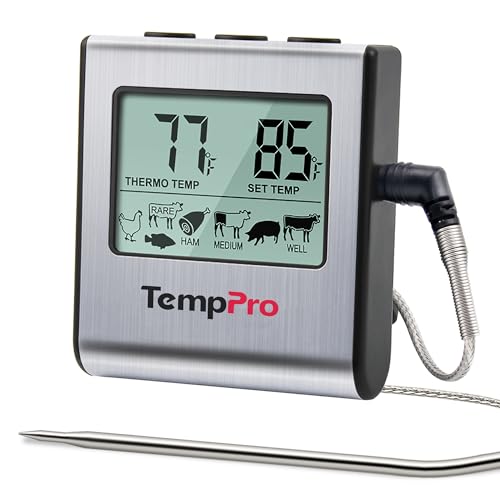
Cook mode with USDA preset temperature settings: TempPro cooking thermometer ideal for meat, oven, smoker or stove top; Programmable alert with preset temperatures for specific foods recommended by USDA; All of the preset temps can be reset to your desired tastes

STAYS IN THE MEAT WHILE IT COOKS, NO BATTERY EVER: Push the 4.5-inch stainless steel probe into the roast, close the oven door and read the 2.5-inch dial through the glass. Bimetal mechanics: nothing to charge, nothing to replace, nothing to set up.

Smart Display Base with Control: The ThermoMaven G1 wireless meat thermometer features a versatile smart display base that offers real-time temperature readings and allows you to set temperatures directly on the device—no app required. With our user-friendly one-click setup, you can connect the probe, pair it with the base, and start cooking in seconds—no complicated setup needed!
The Science of Carryover Cooking and Resting
You’ve confirmed your chicken’s internal temperature at 165°F, but there’s a critical reality you need to understand: the thermometer reading doesn’t represent the final temperature your chicken will reach.
Carryover cooking occurs when residual heat in your chicken’s outer layers continues raising internal temperature after you’ve removed it from the heat source. This phenomenon typically adds 5–10°F to your final temperature. The hotter your cooking environment, the greater this effect—chicken roasted at 425°F experiences substantially more carryover than chicken smoked at 250°F. Regularly checking your thermometer for calibration accuracy ensures you can rely on your readings as you manage carryover cooking.
During meat resting, heat gradually equilibrates throughout the meat, creating even texture from edge to center while preventing overcooking. Pull your chicken at 155–160°F, and carryover cooking safely reaches 165°F without drying out outer layers. This technique produces juicier, more tender results. Accurate thermometer calibration is essential to achieve reliable temperature readings throughout your cooking process.
Balancing Food Safety With Optimal Flavor and Texture
While the USDA’s 165°F guideline guarantees food safety, it doesn’t guarantee ideal eating quality—cooking chicken to this temperature often results in dry, stringy breast meat that’s lost critical moisture. You can achieve superior texture and flavor by targeting lower temperatures with appropriate hold times. Sous vide cooking maintains precise temperatures around 155°F, producing juicier, more tender results while remaining safe. Additionally, using proper packing materials to protect delicate items can help maintain quality in your cooking environment. Alternatively, you can reach 150°F and hold it for five minutes, achieving equivalent pathogen reduction without overcooking. A chicken marinade enhances flavor at these gentler temperatures, compensating for reduced cooking intensity. Checking visual cues like color and texture is also important to ensure proper doneness. Resting your chicken post-thermometer reading allows carryover cooking to complete safe temperatures while finalizing texture development. Accurate time and temperature monitoring remain essential to prevent undercooking.


