You’ll bend glass tubing by adjusting your butane torch to a bright blue flame reaching 1,430–1,970°C, then heating the marked bend point with steady, sweeping motions. Maintain consistent torch distance and pre-heat edges slightly before the center to minimize thermal shock. Once the glass softens, gently apply pressure to create your bend. Afterward, you’ll anneal the piece at 454–482°C for stress relief, then fire polish for smooth, safe edges. The complete process unfolds with precision and patience.
Essential Equipment and Materials
Before you’ll need to gather the right materials and equipment tailored to your specific project. First, select your glass types carefully—soda-lime glass works well for torchworking, while borosilicate glass suits high-temperature applications. Your torch selection depends on the precision required; oxy-propane torches deliver concentrated heating for detailed work, whereas surface-mix torches accommodate larger areas with reduced noise.
Next, secure propane and oxygen supplies, ensuring proper fuel ratios for ideal flame temperature. You’ll need a heat-resistant work surface and fiber blanket material for thermal insulation and workspace protection. Add specialized manipulation tools for shaping hot glass and bead-release formula for applicable projects. Finally, establish adequate ventilation to manage combustion byproducts safely, creating a fire-resistant workspace essential for butane torch operation.

【High Performance】This mini torch can work with propane, acetylene, hydrogen, propylene, natural gas etc to finish jewelry repair work.Two connectors mix the oxygen and acetylene ( gas), to get high performance welding flame. The green one connect with oxygen and red connect gas (Acetylene/Butane/Propane)

A MUST-HAVE BUTANE TORCH FOR YOUR MASTERPIECES: Use the LEXIVON 12-piece butane powered soldering set in a wide range of different applications, from wood burning to wire soldering.

Powerful Flame Temperature Heat up to 5252°F (2900°C)
Preparing Your Glass Tubing for Bending
Since success in glass bending depends entirely on proper preparation, you’ll want to start by selecting borosilicate glass tubing that matches your project’s specifications. Check the tube’s wall thickness for uniformity, and inspect it carefully for cracks, chips, or surface defects that could create weak points during heating.
Next, focus on surface cleanliness by removing all dust, oils, and manufacturing residue using an appropriate solvent or cloth. Dry the tubing completely before proceeding—contaminants cause uneven softening and weak points during flame application. Once clean, mark your bend point clearly using a gentle marking tool that won’t create stress fractures. Position your marked section two inches long, centered on the intended bend area, ensuring even heat distribution across your glass preparation zone.
Understanding Butane Torch Flame Control
Once you’ve prepared your glass tubing, you’ll need to master flame control—the cornerstone of successful bending. You’ll achieve maximum flame efficiency by adjusting your torch’s air mixture slide, located at the top, to produce a bright blue flame. This blue oxidizing flame reaches temperatures between 1,430°C and 1,970°C, providing the heat necessary for precise glass work. Using a fuel type not specified by the manufacturer can lead to dangerous safety hazards, so it’s essential to stick to butane for your butane torch.
Your side-mounted fuel adjuster controls flame size, while the air mixture regulates oxygen flow for temperature calibration. More air creates a hotter, blue flame; less air produces a cooler, yellow flame suitable for gentle heating. Monitor your flame’s color continuously—consistent blue indicates complete combustion and proper temperature. Avoid orange or red flames, which signal insufficient heat and leave unwanted residue on your glass. Effective flame control is crucial, much like maintaining proper protective coating on cast iron cookware to achieve optimal results.

【RTTOOA'S PROPANE TORCH HEAD IS DISTINCTIVE】While other brands were still using traditional techniques, RTTOOA has completed three upgrades. 1. An ergonomic handle was adopted with a non-slip matte finish coating. This provides a more comfortable user experience. 2. The ignition system was improved, increasing the maximum power output from 8,000BTU to 10,000BTU. 3. An pressure regulator was built-in to ensure a 100% ignition success rate, and increase the stability of the flame. This significantly extends the product's lifespan

Versatile 9-piece accessory Soldering kit:Butane torch,2mm conical tip,2mm angle tip,2mm chisel tip,sharp knife,heat deflector,soldering wire,wrench,sponge.

A MUST-HAVE BUTANE TORCH KIT FOR PROFESSIONALS: 13-Piece accessory set to use in a wide range of applications with self-igniting trigger and a flame locking button.
Heating Techniques for Even Temperature Distribution
Now that you’ve mastered flame control, you’ll need to apply that precision through deliberate heating techniques that distribute temperature uniformly across your glass. Employ steady, controlled torch movements using sweeping or circular motions to cover broader areas while avoiding hot spots. Maintain consistent distance between the torch tip and glass surface to reduce temperature gradients within heated zones. Pre-heat glass edges slightly before central areas, minimizing thermal shock and uneven bending stresses. This methodical approach prevents localized overheating that concentrates thermal stress, which causes fractures. Monitor your heating rate between 1.5°C/s to 2.5°C/s, targeting the 600–650°C bending range. Avoid prolonging flame focus on single spots; instead, keep your torch moving deliberately across the entire surface for uniform heat absorption and ideal glass workability.

Flame-Free Electric Design–No Butane Needed: Unlike traditional smoking devices, the whiskey smoker kit all-in-one electric design simplifies the smoking process, simply charge via USB and enjoy up to 130 ignitions per full charge. The magnetic safety cover automatically extinguishes the flame when opened, making safer, convenient and efficient

✱Fuel Gauge and Safety Stopper - With a fuel gauge, a cooking torch help you better control the progress rate of making delicious food, and a broad base helps to prevent it from falling over. A detachable safety stopper can prevent accidental ignition. Professional Piezo Ignition Technology allows one-handed operation, making the operation of the torch easier and safer. A long nozzle can resist high temperatures, and extend the use time of the torch.

Refillable and Adjustable Flame: The butane torch lighter is refillable and compatible with most butane gas refills (Gas is not included in the lighter).Please fill the lighter with butane before using. Ensure that the Switch button is off while filling.
Mastering the Bending Process
With your heating technique refined, you’re ready to execute the actual bend—a process that demands precision from preparation through cooling. Remove the softened glass briefly from the flame and begin bending smoothly; abrupt movements cause fractures. Support the glass above and below the heat zone, applying controlled pressure to achieve your desired angle. For tubes, apply internal pressure by blowing through or sealing ends to prevent wall collapse. Rotate constantly while bending to maintain even thickness and avoid kinks. This methodical approach opens creative applications from artistic curves to functional tubing. When troubleshooting bends, remember that steady motion prevents hot spots and guarantees uniform results. Cool slowly in air for 30-60 seconds, then anneal at lower temperatures to relax the glass structure without reheating.

PRO KIT - Professional's Ready-To-Go Kit with the propane torch head, 6 x Replaceable Heads, Piezo Lighter, and the Storage Box. Upgraded CSA-certified hose for more safety and a Piezo igniter for a higher ignition rate! Perfect for any turbo torch or Map gas torch Kit needs.

1. Ideal for jewelry repair and construction, hobbyists, crafts, metal sculpture, glass blowing, and electronics repair and manufacturing. It can weld an unlimited range of materials.

Butane Gas Not Included – Easy Local Purchase This gas welding torch comes completely empty of butane fuel. Due to hazardous goods shipping restrictions, we cannot ship any flammable butane canisters together with the unit. You can easily find compatible butane fuel at local hardware stores, convenience shops, home improvement centers or offline gas supply retailers nearby.
Maintaining Glass Integrity During Bending
Executing a smooth bend requires more than proper heating technique—you’ll need to actively maintain the glass’s structural integrity throughout the process. Thermal stability depends on rotating the tubing consistently to prevent uneven softening and stress fractures. Seal one end before bending to preserve internal pressure, which reinforces your glass structure against collapse. Apply gentle, steady pressure using a blow hose rather than forcing the bend abruptly. Monitor wall thickness visually; uneven heating causes dangerous thinning. Keep your bend radius gradual to minimize structural strain. Allow the glass to cool gradually afterward—rapid cooling introduces thermal shock that compromises integrity. Inspect stress points carefully for micro-cracks before proceeding.
Annealing Your Bent Glass
After you’ve shaped your glass, the real work of stabilizing it begins—annealing is the controlled heating and cooling process that eliminates the internal stresses created during bending. You’ll heat your piece to 454–482 °C (849–900 °F), holding it there for 30 minutes to several hours depending on thickness. During this soak, glass viscosity drops sufficiently for stress relief, allowing atoms to move freely and relax their molecular bonds.
Next, you’ll cool gradually between the annealing point and strain point at 200–300 °F per hour for larger projects. This methodical descent prevents new stresses from forming. Once below strain point, you can cool faster. The annealing process produces dimensionally stable, durable glass resistant to spontaneous shattering, ready for cutting, drilling, or polishing.
Cooling Procedures for Optimal Results
Once you’ve removed your bent glass from the butane torch’s flame, you’re entering the critical phase where thermal shock poses your greatest risk of failure. Hold the glass steady in air for 30 to 60 seconds, rotating it slowly to maintain form while it stabilizes. Avoid forced air or water quenching—these trigger cracking. Instead, employ ambient temperature air cooling to minimize glass stress and internal fractures.
Only after the piece cools sufficiently should you place it on a clean, heat-resistant surface. Your cooling strategies must prioritize gradual temperature reduction at roughly 150°F per hour. Never expose the glass to drafts or sudden environmental shifts during this critical window. This methodical approach guarantees your bent glass retains its shape while relieving thermal strain completely.
Fire Polishing and Edge Finishing
Now that your glass has cooled completely, you’re ready to refine its edges through fire polishing—a technique that transforms sharp, rough surfaces into smooth, glossy finishes. Position your glass perpendicular to the butane torch’s inner cone, the bright blue region delivering ideal heat. Slowly rotate the piece to distribute warmth evenly across all sides, preventing thermal stress and warping. The fire polishing benefits include eliminating microfractures that create stress points, enhancing optical clarity, and improving handling safety. Your edge finishing techniques should avoid lingering on corners, which risk distortion or excessive melting. Maintain steady, controlled movement throughout. Once polished, continue rotating slowly while cooling to prevent shape distortion and sudden temperature shocks that compromise your results.
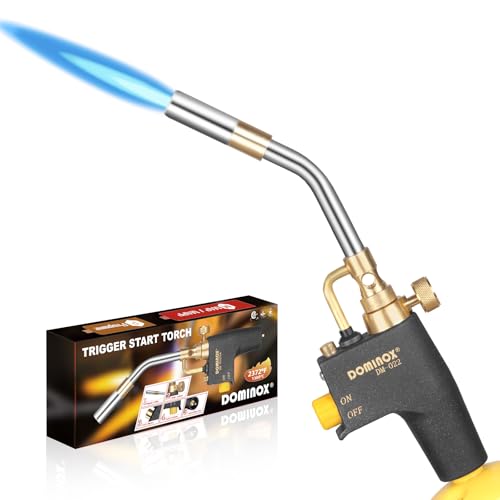
【Powerful Upgrade Propane Torch Head】DOMINOX propane torch head has been upgraded and optimized. 1. The surface of the propane torch handle adopts an anti slip frosted texture to optimize the user experience. 2. The ignition system has been upgraded, the welding torch head can ensure 100% successful ignition every time, improve fuel efficiency. 3. Our map gas torch head is equipped with a pressure regulator inside, you don't have to worry about using it upside down at all, turbo torch can be used upside down for up to 30 minutes.

【Luxurious Appearance & Sturdy Durability】The kitchen torch is crafted from premium metal and fine polished surface, featuring a smooth mirror-like luxury texture. The rugged body is drop-resistant and wear-proof, serving as both a practical tool and an exquisite gift for festivals, birthdays, etc., to showcase taste.

INCLUDES FIVE ACCESSORIES: For soldering, welding, heat blowing, heat deflecting, and flame diffusing
Inspecting Quality and Safety Practices
Before you’ve even lit your butane torch, establishing rigorous inspection protocols safeguards both you and your finished work. Your inspection techniques must verify that all equipment functions properly—check for cracks, loose connections, and fuel quality before starting. Examine your workspace for stability, adequate ventilation, and removed flammable materials. Confirm your safety protocols are in place: accessible fire extinguishers, functional safety glasses, heat-resistant gloves, and flame-resistant clothing. Verify torch stability and secure grip capability to prevent accidental dropping. Test that safety locks engage smoothly when the torch isn’t actively in use. Inspect hose connections for integrity and ascertain flashback arrestors are present. These methodical safety protocols transform potentially dangerous work into controlled, professional glass-bending practice.