You’ll solder successfully by preheating your entire workpiece for even heat distribution, then positioning the torch’s blue cone tip at the conductor. Apply flux generously to enhance solder flow. Once the metal reaches proper temperature, feed lead-free solder into the joint—don’t overheat or you’ll weaken the bond. Remove heat immediately after solder flows completely. Inspect your finished joint; quality bonds appear smooth and shiny. Mastering these fundamentals opens doors to more advanced joining techniques.
Preparation and Tools Required
Before you strike your first flame, you’ll need to prepare your workspace and gather the proper equipment to solder safely with a butane torch. Set up your work surface with fireproof materials like sheet metal or ceramic tiles, then place a Solderite board or charcoal block on top. Keep a fire extinguisher within arm’s reach and guarantee adequate ventilation.
Assemble your essential tools: a butane torch with adjustable flame control, pliers, wire cutters, and a third-hand tool for securing workpieces. Gather your soldering materials, including copper wire, lead-free solder, and flux. Wear safety glasses, heat-resistant gloves, and an apron. Clean metal surfaces with emery cloth, apply flux to joints, and clamp pieces in place. You’re now ready to begin soldering.

【Effortless One-Handed Operation】With the flame regulator and flame lock button easily in reach of your thumb, adjust and lock the flame with just one hand. Never again do you need to free up the other hand to assist.
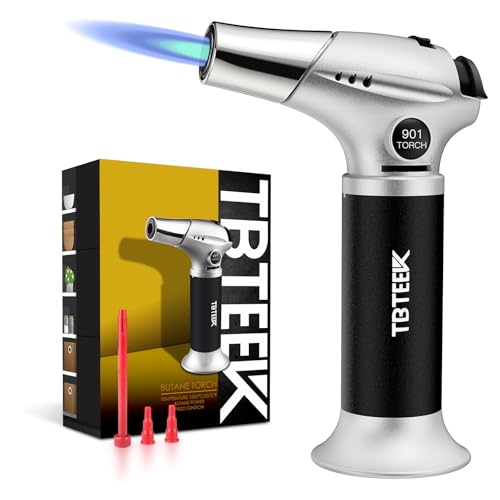
Safe and Sturdy Creme Brulee Torch: The safety lock could prevent accidental ignition. Also the ergonomic design provides comfort to your hand and keep away from the flame; the aluminum alloy material adopted makes it more resistant and sturdy, ensuring the longevity (Note: After each use, please turn the flame adjustment valve to the lowest level(OFF Position), and engaging the safety lock for indicent ignition)

Note: TANK AND PROPANE ADAPTER ISN’T INCLUDED. For first-time use, the recommended knob rotation range is 30° to 90°.
Torch Setup and Operation
With your workspace prepared and equipment assembled, you’re ready to set up and operate your butane torch. Different torch types offer varying flame characteristics, so select one suited to your soldering needs. Begin by filling the butane cartridge according to manufacturer instructions, using a proper nozzle and pumping action for complete fuel transfer. Allow twenty seconds for settling before ignition.
Engage the ignition button after lifting the safety lock. Let the flame burn five to ten seconds initially to stabilize internal components. Use flame control to adjust the flame size and intensity, rotating the air/oxygen collar to shape the inner blue cone for maximum heat concentration. Maintaining minimum necessary flame settings for efficiency and safety is crucial, especially when performing tasks like soldering with precision which requires consistent heat application.
It’s important to note that while butane torches can be effective for soldering, they generally do not reach the temperatures required for melting glass, which can exceed 1,400°C (2,552°F).
Hold the torch at an angle, moving it in gentle circles to heat your workpiece uniformly before focusing on the joint.

Butane Gas Not Included – Easy Local Purchase This gas welding torch comes completely empty of butane fuel. Due to hazardous goods shipping restrictions, we cannot ship any flammable butane canisters together with the unit. You can easily find compatible butane fuel at local hardware stores, convenience shops, home improvement centers or offline gas supply retailers nearby.

A MUST-HAVE BUTANE TORCH KIT FOR PROFESSIONALS: 13-Piece accessory set to use in a wide range of applications with self-igniting trigger and a flame locking button.

Used for Construction - Concrete & Metal Tools, Soldering/Heat Guns
Technique for Heating and Soldering
Now that you’ve mastered torch setup and operation, proper heating technique becomes critical to achieving reliable solder joints. Begin your heating sequence by preheating the entire workpiece with slow, methodical torch rotation to guarantee even temperature distribution. Direct the inner blue cone tip at the conductor, concentrating maximum heat transfer. Avoid overheating—slight color changes signal readiness. Once the metal reaches proper temperature, apply solder directly to the heated surface, not the flame. Maintain continuous heat until solder flow occurs completely, filling the joint uniformly. Use flux to enhance heat retention and flow characteristics. Remove heat immediately after solder flows fully to prevent melting or warping. This controlled approach guarantees strong, clean bonds every time, as butane torches are best suited for light brazing or soldering rather than full fusion welding on thicker metals.
Safety Considerations
While mastering proper heating technique guarantees you’ll create reliable solder joints, you’ll also need to prioritize safety procedures that protect you, your workspace, and those around you.
Your personal protective equipment must include safety goggles designed for flame flare, heat-resistant gloves rated for 450°C contact, and flame-resistant clothing covering your arms and legs. Consider adding a welding helmet for face and neck protection against radiation.
Environmental safety requires you to operate in well-ventilated areas and remove all flammable materials from your workspace. Position extraction systems to direct fumes away from your breathing zone. Work on heat-resistant surfaces like sheet metal or ceramic tiles, keeping fire extinguishers nearby. Store butane canisters in locked cupboards away from heat and sunlight, and always fill your torch away from ignition sources. Additionally, it’s best to use butane torches with built-in automatic ignition systems to ensure safer lighting practices and minimize the risk of accidents.
Common Challenges and Tips
Even as you’ve mastered the fundamentals of butane torch soldering, you’ll encounter obstacles that can compromise your joints’ quality and durability. Maintaining proper flame temperature proves critical—excessive heat melts solder and damages pipe surfaces, while insufficient heat creates weak, porous joints. You’ll need high-quality filtered butane to guarantee consistent combustion and prevent clogging that disrupts your workflow. Additionally, understanding the importance of tip selection can enhance your soldering efficiency and overall results. Butane torches can also be used to provide quick, targeted heat, making them a versatile tool in both culinary and soldering tasks.
Before soldering, clean copper surfaces thoroughly with emery cloth to remove oxidation and corrosion. Apply flux generously to facilitate solder flow and improve solder joint integrity. Monitor your torch tip’s condition, as carbon buildup reduces heat transfer efficiency.
After joining, inspect your work carefully. Quality solder joints appear smooth, shiny, and bright without black discoloration. Dull or ball-shaped accumulations indicate temperature problems requiring adjustment.

PREMIUM BUTANE GAS: Colibri butane is the cleanest available at 99.9994% purity. Produced to the exacting standards required by high-performance jet-flame lighters, resulting in fuel so pure it does not require repeated filter-ing, like other brands.

SUPERIOR PERFORMANCE: XIKAR Purofine Premium Butane Fuel is meticulously crafted to deliver unparalleled performance. Specially formulated for jet flame lighters, it ensures a consistent and powerful flame, making it ideal for lighting cigars.

MAXIMIZE TORCH PERFORMANCE: ZeroR’s 100% pure iso-butane gas for lighter refill ensures a clean, efficient burn with less residue. Avoid the issues caused by cheaper fuel mixes, and get superior performance & lasting blaze for your torch every time
Applications and Effectiveness
Butane torches excel across diverse soldering applications because they’re portable, efficient, and adaptable to different materials and environments. You’ll find them invaluable for plumbing repairs, where they quickly solder copper pipes up to 2 inches thick with superior flame coverage compared to soldering irons. For electronic components, you’ll appreciate their precise heat control and one-handed operation in tight spaces, protecting sensitive materials from damage. Additionally, these torches are favored by chefs for their compact and portable design that makes them ideal for kitchen use. In jewelry crafting, you’ll leverage their fine flame control for delicate metalwork on silver and copper while minimizing contamination. For automotive repairs, you’ll use concentrated heat to loosen rusted fasteners and handle emergency electrical repairs where portability matters most. This versatility makes butane torches your go-to solution across industries and field conditions. Always remember to follow safe refilling tips to ensure your torch operates efficiently and safely for these tasks.