Worried about whether infrared thermometers are safe to use on your body? The good news is that they are generally considered safe because they don’t emit any harmful radiation; they just measure the heat your body naturally emits.
The small red laser you see is only for aiming, not part of the measurement process. Keep reading to learn how to use them safely and get accurate readings.
How Infrared Thermometers Actually Work (Without Harming You)
Infrared thermometers work passively by detecting radiation emitted from your body’s surface. They do not send out any energy of their own; instead, they measure only what is already leaving your skin. The device captures infrared radiation, which increases as your surface temperature rises. Since it only measures this emitted radiation, it doesn’t interact with or alter your body in any way. This makes the process safe, quick, and non-invasive, providing an accurate surface temperature reading without any risk or discomfort. The thermal pile within the device converts this captured infrared energy into heat, which is then transformed into electrical signals for measurement. This passive detection method is similar to how a household vinegar spray safely removes rust without emitting any harmful energy. For the most durable surface, you should apply a thin layer of a high smoke point oil to your cast iron skillet, mirroring how the thermometer simply reads what is already present. Interestingly, this same principle of passive measurement is used when monitoring the temperature of a sourdough loaf during baking in a covered pot.

✨Swift Results in Just 1 Second: Experience the efficiency of ANMEATE thermometer for adults with its remarkable 1-second read capability. Obtain accurate temperature readings swiftly, providing you with timely and dependable results.
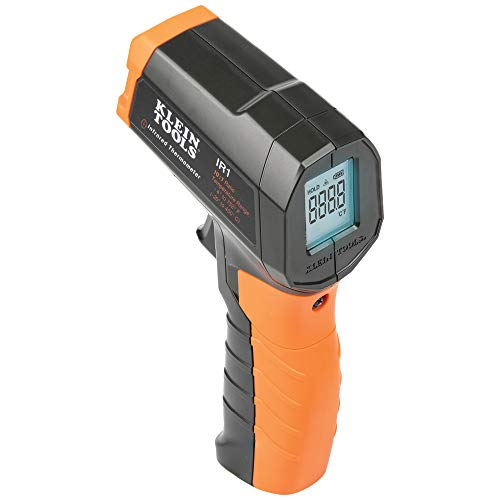
PRECISE TEMPERATURE MEASUREMENT: Optical resolution (distance-to-spot) of 10:1 ensures accurate temperature readings from a distance

Temperature measurement range:-50℃-500℃ (-58℉-932℉)Display resolution: 0.1 ℃ or 0.1 ℉
What the Red Light on Infrared Thermometers Really Is: And Why It’s Safe
The red light on infrared thermometers is a visible laser pointer used for aiming, not for measurement. Its primary purpose is to help you target the exact spot on the body where you want to take a temperature. The laser emits low-energy visible light that travels in a straight line, guiding you to the correct area without emitting heat or risk to your skin. Importantly, this laser conforms to safety standards designed to prevent any harm. You can see the red dot as a visible indicator that the device is active, but it does not produce any thermal effect or damage. It’s simply a targeting aid to ensure accurate readings, and its presence is entirely safe. This is unlike the precise temperature control used in sous vide cooking, where actual heat is applied to achieve specific food textures. This targeting method is far less invasive than checking a whole chicken for doneness using a probe thermometer inserted into the thigh. For grill surface readings, a dedicated infrared thermometer is far more accurate than relying on a built-in hood thermometer that can be significantly off.
Do Infrared Thermometers Pose Risks to Your Eyes or Skin?
Infrared thermometers do not pose risks to your eyes or skin when used correctly. These devices rely on passive mid-infrared sensors that detect only the thermal radiation emitted by your body, not any harmful beams. The radiation they emit is very low energy and does not penetrate deeply into the tissue, so it cannot cause damage or burns.
You can rest assured that a quick forehead scan won’t harm your skin or eyes. The brief measurement process and non-contact design keep the risk of injury minimal. In fact, skin redness or burns only occur after prolonged, intense contact—something you won’t experience during standard use. Because infrared thermometers do not produce any dangerous radiation, eye damage or skin burns are highly unlikely under normal circumstances.
Additionally, these devices are environmentally friendly. They eliminate the need for disposable probes, reducing waste and making them a safer choice for public health screening. The measurement process is similar to how a cast iron skillet detects heat without emitting harmful energy. Overall, using an infrared thermometer correctly is safe and poses no significant risk to your eyes or skin.

No-Contact Thermometer: GoodBaby touchless thermometer provides contactless accurate temperature reading that helps you avoid cross infections. No need to clean the thermometer after every use

Non-Contact Technology For Safe & Hygienic Use: With a built-in infrared temperature sensor, the iHealth PT3 thermometer can read a person’s body temperature within 1.18 inches from the center of the forehead without physically touching the person.

Non-contact Thermometer: According to the infrared technology, you can measure body temperature without touching the ear or the forehead, prevent cross-infection between multiple people. Measurement Distance: 2-3.15 inch.
What the FDA and Health Officials Say About Safety
Infrared thermometers are generally safe for eyes and skin when used correctly. The FDA emphasizes that proper operation is crucial because inaccurate readings caused by misuse pose a greater public health risk than device-related harm. Regulatory approval of these devices depends on them meeting specific performance standards, but many have been exempted from premarket review since they are considered unlikely to raise new safety concerns. Despite this, following safety guidelines is essential. You should hold the thermometer perpendicular to a clean, dry forehead and ensure the environmental temperature remains between 60.8 and 104 degrees Fahrenheit. Avoid scanning multiple people at once, as this increases the chance of error. Using the device improperly can give you a false sense of security, which is more dangerous to public health than any potential device flaw. However, it is important to note that infrared thermometers primarily measure surface temperatures rather than internal body temperature directly. These devices also offer hygiene benefits because they do not require cleaning after each use like contact thermometers. Unlike for humans, infrared thermometers are not currently recommended for precise health monitoring in dogs, as studies show they are often inaccurate compared to rectal thermometers.

Get reliable, precise temperature readings in just 1 second with this no-touch forehead thermometer. Equipped with a high-sensitivity infrared sensor, it delivers consistent results for babies, children, and adults, giving you peace of mind whenever you need to check for fever. The thermometer supports both ℉ and ℃ switching, meeting all your daily temperature measurement needs at home.

High Accuracy & Reliable Performance: This VIEK infrared thermometer delivers precise readings (±0.4°F) for infants, children, and adults, designed for consistent and dependable temperature monitoring at home.

★【MULTI-MODE THERMOMETER】:The Berrcom forehead thermometer is designed for all ages, adults, infants and elders. It not only supports forehead function, but is able to take room/object temperature. ℃ and ℉ are easily switchable.
Why Infrared Thermometer Accuracy Is a Concern: But Safety Is Not
Infrared thermometers are often inaccurate, making them unreliable for detecting fevers. Errors can range from minus 3 degrees Celsius to plus 2 degrees Celsius, far exceeding the acceptable margin of just 0.3 degrees. This calibration problem leads to significant measurement variability, where different devices or even the same device at different times can give different readings. Sensor inaccuracies and flawed algorithms further complicate the problem, often resulting in errors that depend more on the specific device than on your technique. Consequently, the sensitivity for detecting fevers above 38 degrees Celsius can be as low as 13 percent, which means false negatives are common. You might miss a fever, especially near the CDC’s threshold, putting safety at risk. Environmental factors such as drafts or nearby heat sources can further degrade accuracy. While your safety from using the device isn’t compromised, trusting the temperature reading it provides can be misleading. Achieving a reliable cook requires monitoring internal temperature with a precision probe, much like searing a ribeye in a very hot skillet. Unlike dedicated vacuum sealers, a regular vacuum cleaner cannot create proper seals needed for safely extending food storage life and preventing bacterial growth. Using low cooking temperatures on the stovetop instead is a reliable method for ensuring tender, flavorful meat without a specialized pot.

【Highly Accurate & Adjusts to Any Surface】Designed with the latest thermopile sensor technology, the infrared laser thermometer gun is accurate to +/-1.5%; Improve this pizza oven thermometer gun measurements by adjusting the emissivity from 0.1–1.0 to match the surface material being measured

【CAL Function for Stable Reading】 Features exclusive one-button calibration technology to maintain measurement consistency for objects over time, effectively countering the reading drift often seen in standard thermometers. Our advanced sensor delivers dependable data for your projects.

𝐕𝐞𝐫𝐬𝐚𝐭𝐢𝐥𝐞 𝐓𝐨𝐨𝐥𝐬: Infrared technology allows you to measure various objects at home and outdoors; Use it for 𝒎𝒆𝒂𝒕, 𝑫𝑰𝒀 𝒄𝒂𝒏𝒅𝒚, 𝒐𝒗𝒆𝒏𝒔, 𝒈𝒓𝒊𝒍𝒍𝒊𝒏𝒈, 𝒇𝒐𝒐𝒅, 𝒄𝒐𝒐𝒌𝒊𝒏𝒈, 𝒂𝒖𝒕𝒐𝒎𝒐𝒕𝒊𝒗𝒆 𝒖𝒔𝒆, 𝑨/𝑪, 𝒓𝒆𝒇𝒓𝒊𝒈𝒆𝒓𝒂𝒕𝒐𝒓𝒔, etc.
How to Use an Infrared Thermometer Correctly for Reliable Readings
To ensure accurate readings with an infrared thermometer, follow a precise setup and measurement routine. Begin by addressing environmental factors: turn on the device and let it warm up for 15 minutes before use. Afterward, leave the thermometer in the room for at least 30 minutes so it can acclimate to the ambient temperature. Maintain the room temperature between 60.8 and 104 degrees Fahrenheit and keep humidity below 85 percent to prevent environmental interference.
Choose a draft-free space away from direct sunlight, as external elements can affect the accuracy. Regularly calibrate your device by cleaning the lens daily with a soft cloth to remove dust or smudges that could distort readings. When taking a measurement, hold the thermometer 3 to 5 centimeters from the temple, positioning it perpendicular to the forehead. Remove any hats, glasses, or sweat that could obstruct the sensor or alter the temperature reading.
Point the device at the right eyebrow, ensuring the sensor is aligned properly. Wait approximately 15 seconds for the thermometer to display the reading. If the device shows an “H” or “L,” it indicates the need to retake the measurement to confirm accuracy. To improve reliability, always adhere to the distance-to-spot ratio to measure the correct area of the forehead. Always avoid immersing the unit in water or exposing it to excessive moisture, which can damage sensitive components. Adhering to these steps will help you obtain reliable, consistent temperature readings.
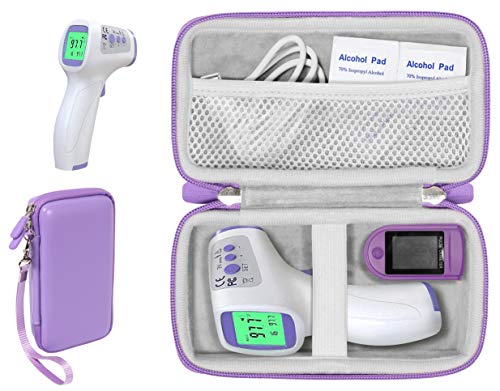
Perfectly for Forehead ThermometFeatured handy caser: all in one case for Forehead Thermometer case for Non-Contact Infrared Digital Thermometer Like Vibeey, eZthings, HALIDODO, HIGBRE, ALLIRIER, AFARELY, ROYADVE, REDESS, iCode, SUNNYPLUS, BrillianceHair, drtulz, easy carrying with excellent protectioner like Non-Contact Infrared Digital Thermometer Like Vibeey, eZthings, HALIDODO, HIGBRE, ALLIRIER, AFARELY, ROYADVE, REDESS, iCode, SUNNYPLUS, BrillianceHair, drtulz

Non-Contact Thermometers: Berrcom Forehead Thermometer features durable ABS housing; ergonomically designed for measuring forehead, indoor temperature, or food; offers 32-memory storage, one-touch mute, °F/°C switching, and 30-second auto shut-off for family use

【2-in-1 Infrared & Probe Thermometer】Perfect for home chefs, grilling enthusiasts and DIY hobbyists who demand professional control; Use the IR sensor for safely checking pan, oven, or grill surface temps, and the meat probe for perfectly cooked meats, candy, or frying oil
Why You Should Never Use an Industrial Thermometer on a Person
Using an industrial thermometer on a person is highly dangerous and unreliable. These devices often contain toxic liquids like mercury or combustible chemicals that can spill if broken, posing serious health hazards such as poisoning or burns. Moreover, industrial thermometers are calibrated for a wide temperature range, sometimes spanning hundreds of degrees, which makes them inaccurate within the narrow 90°F to 110°F human body temperature zone. This can lead to readings that are off by as much as 5°C, making it difficult to accurately detect fevers. Relying on such a device risks false negatives, meaning you might miss a fever and overlook an infection, or false positives, which can cause unnecessary alarm. Additionally, industrial models have a higher margin of error compared to medical thermometers, making them unsuitable for fever detection. Regulatory agencies, including the FDA, explicitly prohibit using industrial thermometers for medical purposes. Instead, choose a medical-grade thermometer designed specifically for measuring human body temperature—it’s safer, more reliable, and costs less in the long run.