You’ll insert your digital thermometer’s probe at least ½ inch into the thickest part of the breast or thigh, avoiding bone contact that causes false high readings. Position it at a slight angle through the thigh to bypass skeletal structures. Target 165°F for white meat and 175°F for dark meat. Check multiple spots to confirm doneness. Allow the chicken to rest five minutes afterward to redistribute juices for ideal results and flavor retention.
Choosing the Right Thermometer for Accurate Readings
When you’re cooking chicken, selecting the right thermometer is fundamental to food safety and preventing both undercooking and overcooking. Digital thermometers provide fast, accurate readings within ±0.9°F, making them essential for achieving the safe 165°F internal temperature. You’ll want a model with high accuracy (±1°F or better) and quick response times to minimize guesswork.
Probe durability matters greatly for long-term reliability. Choose stainless steel probes that resist corrosion and withstand repeated high-heat use. Thin probes minimize meat damage while stabilizing temperature readings faster. Waterproof or water-resistant designs simplify cleaning and prevent moisture damage. The best options, like the Typhur Gold, are specifically designed for precision cooking.
Look for large, backlit digital displays for easy readability, especially in dim kitchen or grill environments. Consider leave-in probe thermometers that monitor temperature during cooking without opening your oven, maintaining consistent heat. Additionally, some advanced wireless smart meat thermometers include ambient temperature sensors that enhance the cooking process. These features combine to guarantee accurate, reliable chicken cooking every time.

【Fast & Accurate】Our meat thermometer digital delivers accurate readings within ±1°F in just 1–2 seconds, with a wide temperature range of -58°F to 572°F (-50°C to 300°C). No more waiting over the heat - know your food's exact temperature instantly.

Instant Read Meat Thermometer | Our instant read thermometer features a temperature probe and advanced, highly accurate technology with a 1-2 second response time. Our instant read food thermometer comes pre-calibrated with instructions and a meat temperature chart, plus a recalibration feature if needed.

Fast and Accurate Reading: Kitchen thermometer for cooking features a 1 second readout speed and high accuracy of +/-0.9 degrees Fahrenheit, ensuring you receive the most delicious results every time
Proper Probe Placement and Insertion Techniques
Once you’ve selected your thermometer, proper placement determines whether you’ll get an accurate 165°F reading or a dangerously misleading one. Insert your probe at least ½ inch deep into the thickest part of the breast or thigh, positioning the sensor centrally within boneless muscle. Avoid bone contact entirely—bone conducts heat faster, causing false high readings that risk serving undercooked chicken. Use insertion techniques that prioritize accuracy: approach the thigh at a slight angle, inserting from back toward rib to bypass skeletal structures. Fully insert the probe so only the handle remains exposed, preventing surface temperature distortion. Insert early in cooking to monitor continuously without repeated poking that compromises juiciness and accuracy. Firm, deliberate insertion protects both your probe and the meat’s integrity. Proper use of a meat thermometer ensures you reach the critical safe serving temperature of 165°F, effectively killing harmful bacteria that can cause foodborne illnesses.

Completely Waterproof: IPX6 waterproof rating means you can wash this cooking thermometer under running water without fear. This food thermometer for cooking ensures cleanup is ultra-fast

Temperature Range: 140° to 190°F / 60° to 87°C. Probe Length: 4.75-inches Dial Diameter: 2.375-inches

【8X Faster + 4X More Precise】: Upgraded with an industrial-leading professional thermocouple sensor, Themomonster meat thermometer digital with NIST certified ±0.5℉ precision provides you the accurate temperature of your food in just 0.5 Seconds.
Understanding Temperature Gradients and Safe Minimums
As chicken cooks, heat doesn’t penetrate uniformly—the exterior reaches target temperature long before the center does, creating a temperature gradient that you must account for when checking doneness. The thickest section is always the last to reach your target temperature, making it your critical measurement point. Oven-safe probe thermometers can be used to continuously monitor the temperature during cooking, ensuring accuracy without needing to open the oven.
You’ll notice temperature variations are more pronounced in larger cuts like whole chickens or thick breasts than in smaller pieces like wings. This matters for food safety because you’re measuring the slowest-cooking area.
The USDA’s safe minimum internal temperature for all chicken cuts is 165°F (74°C). At this temperature, harmful bacteria like Salmonella and Campylobacter are destroyed almost instantly. Don’t rely on lower temperatures without precise timing—food safety depends on meeting this standard. Using a meat thermometer ensures the desired level of doneness is reached safely and consistently.
Navigating Bone-In and Skin-On Chicken Cuts
Why does bone-in, skin-on chicken require different thermometer technique than boneless cuts? Bones conduct heat differently than muscle, creating thermal gradients that complicate accurate readings. You’ll find that bone conduction can lag behind actual meat temperature, potentially giving false high readings if your probe touches bone. To ensure accuracy, it’s best to use a digital probe thermometer for measuring internal temperatures.
Lift the skin gently and insert your thermometer directly into the meat, avoiding fat pockets and cartilage. Position your probe in the thickest section near the bone without touching it. For breasts, target 165°F (74°C); for dark meat, aim for 175°F (79°C). Use an instant-read thermometer to capture the lowest temperature as you move the probe through different areas. Check multiple spots to confirm overall doneness, ensuring food safety without overdrying your chicken. Additionally, be mindful that high smoke point oil can impact overall cooking results by adding flavors and moisture.
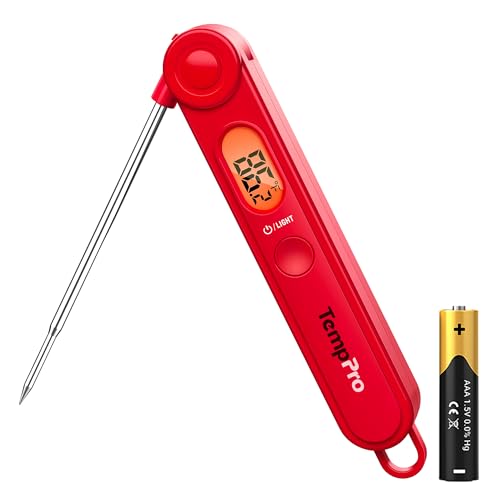
【Easy to Use】Easily release the meat probe at the push of a button, and control the backlight or power with another button. With TempPro, cooking becomes a seamless, stress-free experience

FAST & ACCURATE INSTANT READ: Get temperature readings in just 2-3 seconds with ±1°F accuracy. Whether you're grilling steaks, roasting turkey, smoking brisket, or baking bread, this digital meat thermometer helps you monitor food temperature quickly and confidently

Intermediate Cooking Methods for Optimal Results
To elevate your chicken beyond basic cooking, you’ll want to employ thermometer-guided techniques that balance food safety with ideal texture and flavor. Reverse searing offers precision control: cook chicken with indirect heat until it reaches 145–150°F (63–66°C) internally. Then finish with direct high heat for approximately 3 minutes per side, developing a caramelized crust while bringing the temperature closer to safe levels. Check your oven’s true temperature to ensure that cooking times and results are consistent. Apply BBQ sauce during the searing phase for enhanced flavor and slight caramelization. Your thermometer readings guide sear timing, preventing overcooking or moisture loss. Proper insertion technique ensures that the thermometer accurately measures the core temperature for safe results. After cooking, allow the chicken to rest 5 minutes—this redistributes juices and finalizes internal temperature, ensuring best results.