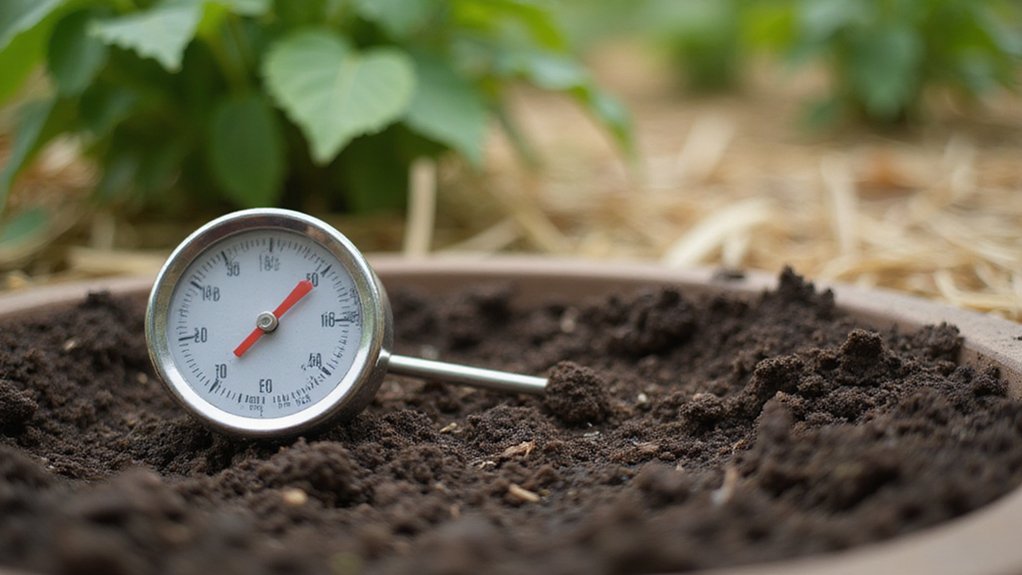
Wondering if a meat thermometer can help you check soil temperature? It’s actually a surprisingly handy tool for small gardening tasks, especially if you don’t have a dedicated soil thermometer.
Calibrating it properly and knowing its limitations can make all the difference. Keep reading to learn how to use a meat thermometer effectively for this purpose.
Is a Meat Thermometer Actually Accurate for Soil Temperature?
Digital meat thermometers are actually quite accurate for measuring soil temperature, often more reliable than dedicated soil thermometers. You can verify their accuracy at home through temperature calibration. To do this, test your device in an ice water slush, which should register around 32°F, and then adjust it with the hex bolt if your model allows. Keep in mind device limitations: boiling water calibration requires altitude adjustment because water boils at 212°F only at sea level. If your readings deviate more than 2°F from these standards, stop using the device for soil measurements. If your thermometer probe becomes rusty, you can use a vinegar spray solution to remove light rust, but avoid leaving it for more than 30 minutes to prevent pitting damage. Digital instant-read models typically maintain a tolerance of about ±1°F to ±2°F, making them more precise than dial-type thermometers. When measuring soil temperature, insert the probe to a depth of 4 inches, ensuring it is not near rocks or other obstructions that could damage the sensor or give inaccurate readings. For best results, wait at least 1-2 minutes after inserting the probe, as soil testers show close readings only after a brief acclimation period. However, unlike vacuum sealer bags designed for sous vide, a meat thermometer probe lacks the material thickness and heat-seal compatibility needed for immersion in a sealed water bath, so it should only be used for spot-checking soil temperature. For tasks requiring sustained or precise heat application, such as soldering, selecting the right soldering tip for butane torches can improve heat transfer efficiency and control.

【Fast & Accurate】Our meat thermometer digital delivers accurate readings within ±1°F in just 1–2 seconds, with a wide temperature range of -58°F to 572°F (-50°C to 300°C). No more waiting over the heat - know your food's exact temperature instantly.

Instant Read Meat Thermometer | Our instant read thermometer features a temperature probe and advanced, highly accurate technology with a 1-2 second response time. Our instant read food thermometer comes pre-calibrated with instructions and a meat temperature chart, plus a recalibration feature if needed.

Fast and Accurate Reading: Kitchen thermometer for cooking features a 1 second readout speed and high accuracy of +/-0.9 degrees Fahrenheit, ensuring you receive the most delicious results every time
Can a Meat Thermometer Reach Your Garden’s Root Zone?
A typical meat thermometer probe, which measures only 4 to 5 inches, cannot reach the root zone of taller plants and trees in your garden. While the probe might access the soil surface, it falls short of the 6 inches or more needed to accurately gauge root-level temperature. Digging away topsoil is feasible for shallow-rooted seedlings but impractical and harmful for established plants with extensive root systems. Additionally, a meat thermometer cannot measure soil moisture or pH, both crucial for root health. Its plastic housing quickly deteriorates in abrasive soil, and its sensor isn’t designed for long-term exposure to damp conditions. Angling the probe might give a slightly different reading, but it tends to bias measurements warmer. For precise root-zone temperature readings, a dedicated compost thermometer with an 18-inch probe, built to withstand soil conditions, is the right choice. By contrast, Dutch ovens are designed to retain heat evenly for slow-cooked dishes, making them a versatile tool for budget-friendly meals rather than garden tasks. Similar to the limitations of infrared thermometers for pets, a meat thermometer’s non-contact readings would be unreliable for measuring deep soil temperatures. For a similar reason, the vacuum sealing process used in meat preservation fails to create the proper environment for dry aging without specialized permeable bags that allow moisture and oxygen exchange.
How to Take a Reliable Soil Temperature Reading (Timing, Depth, Consistency)
To get a reliable soil temperature reading, you should measure at a consistent time, depth, and location each day. Try taking readings between 8 and 10 AM for a stable daily average or during the early afternoon, around 1 or 2 PM in summer for peak root-zone temperatures. The key is to compare readings taken at the same time daily to observe true trends rather than short-term fluctuations. For culinary tasks requiring similar precision, a thermometer offering ±0.5°F accuracy can provide instant spot-check readings, preventing unwanted crystallization in candy making.
Dig down to a depth of 4 inches for general health checks or 2 inches when evaluating germination conditions. Stick to the same spot by marking it with flags or small markers to avoid confusing readings from different locations. Take three to five measurements per session and calculate the average to minimize effects from microclimate differences like shade or ground cover. Keep soil moisture in mind because wetter soil tends to read cooler and experience less temperature fluctuation. Always record soil conditions along with temperature to better interpret your results. When measuring, press the probe firmly into the soil, clear away any debris, and allow it to stabilize for 3 to 5 minutes before recording the temperature. Consistency in timing, depth, and technique will yield the most dependable data for your gardening or farming decisions. Recognizing microclimate differences within a garden is critical for accurate planting decisions, as parts of your garden in full sun can have marginally higher soil temperatures than shaded spots. Similar precision is required for culinary tasks, such as achieving precise temperature control for egg textures when using a sous vide setup. For busy families cooking outdoors, the same thermometer could help ensure rapid cooking in a Dutch oven without burning the meal.
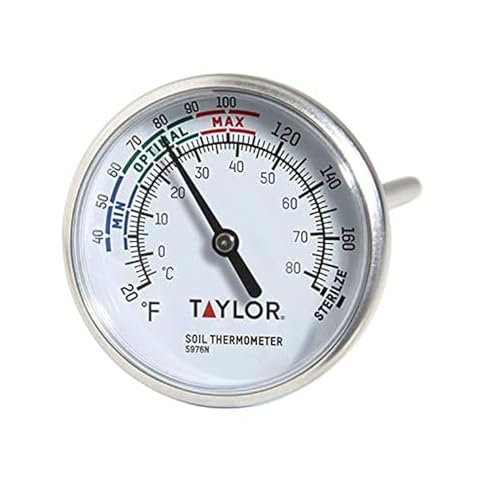
PRECISE SOIL TEMPERATURE READINGS: Measures soil temperatures from 20 degrees F to 180 degrees F (0 degrees C to 80 degrees C) with a large, easy-to-read analog dial face - no batteries or digital screens needed for reliable results every time

Easy-to-read green, yellow, and red tick marks for easy monitoring
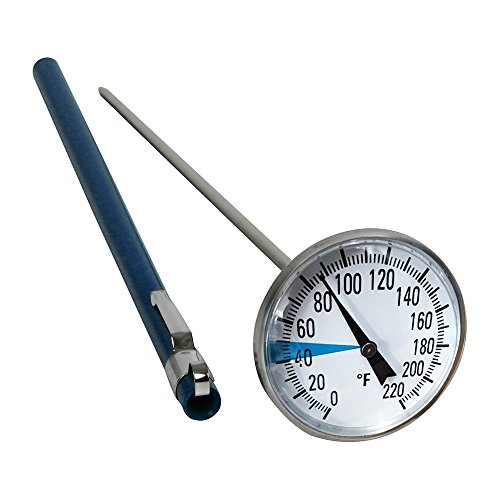
PRACTICAL SOLUTION - While other Soil Thermometers can’t tell the correct temperature, fogs up, and get broken easily, our soil thermometer has high precision performance, high-visibility, and is designed to last
How to Calibrate a Meat Thermometer for Soil Temperature Accuracy
To ensure your soil temperature readings are accurate, calibrate your meat thermometer carefully. Start with an ice bath: fill a container with crushed ice, add just enough cold water to fill the gaps, and stir until the mixture reaches 32°F (0°C). Immerse the thermometer stem at least 2 inches deep, avoiding contact with the container walls or bottom. Wait about 10 seconds until the reading stabilizes. If the thermometer shows more than a +/- 0.5°C difference from the known temperature, adjust the calibration nut on the dial to correct it. For calibration accuracy, a 2°C difference is acceptable between thermometers, ensuring consistent readiness.
Alternatively, you can use the boiling water method at sea level, where water boils at 212°F (100°C). Fill a container with boiling water, immediately submerge the stem at least 2 inches, and wait for stability. Keep in mind that altitude affects the boiling point; higher elevations lower it, so adjustments are necessary accordingly. For digital probes, consult the user manual for calibration options—many have built-in settings. If your thermometer doesn’t allow calibration adjustments, mark the offset with a piece of tape to remember the correction needed. Regular calibration ensures your soil temperature readings are dependable and precise, similar to following a trusted recipe or cooking tip. For absolute accuracy, compare your readings against a NIST-certified reference thermometer before using your soil measurements in critical decisions.

【8X Faster + 4X More Precise】: Upgraded with an industrial-leading professional thermocouple sensor, Themomonster meat thermometer digital with NIST certified ±0.5℉ precision provides you the accurate temperature of your food in just 0.5 Seconds.

【Fast & Accurate】Our meat thermometer digital delivers accurate readings within ±1°F in just 1–2 seconds, with a wide temperature range of -58°F to 572°F (-50°C to 300°C). No more waiting over the heat - know your food's exact temperature instantly.

[Ultra-Fast and Highly Accurate] - With a precision sensor, this Digital meat thermometer reads temperature in 3 seconds and is accurate within 1 °F . Supporting Celsius and Fahrenheit display from -58°F to 572°F (-50°C to 300°C).
Can You Use a Meat Thermometer for Soil Without Ruining It? (Cleaning and Hygiene)
Yes, you can use a meat thermometer in soil, but thorough cleaning is essential to prevent damage and contamination. Immediately rinse the probe after soil contact to remove dirt and organic debris. Dry it completely to avoid moisture buildup that could cause corrosion or bacterial growth. Use a mild detergent or disinfectant wipe to sanitize the probe before switching back to food preparation. Avoid submerging non-waterproof digital units, as water can damage the electronic components. Carefully inspect the probe for residual soil particles, which can harbor harmful bacteria like E. coli or Salmonella. This tool is effective for landscape management because it provides an accurate reading of ground conditions. Proper cleaning and maintenance preserve the probe’s accuracy and durability while preventing garden toxins from transferring to your food. As with caring for cookware, using non-abrasive sponges ensures the probe’s surface stays free of scratches and contamination. For instance, sous vide cooking also relies on precise temperature control to achieve perfect textures and flavors in meats and vegetables. However, unlike a Dutch oven’s heat retention, a meat thermometer probe is not designed for prolonged exposure to high heat in an oven.