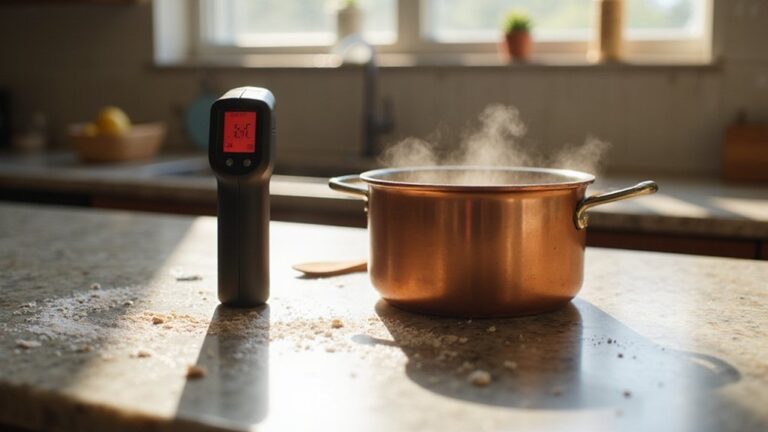
Yes, you can confidently use a Thermapen for candy making. You’ll benefit from its ±0.5°F accuracy and sub-one-second response time, which help you hit precise sugar stages without overcooking risks. Its slim probe minimizes crystal nucleation, while the quick-wipe surface enables fast spot-checking throughout your pot. The device monitors all candy temperatures from 230°F to 350°F effectively. Understanding how to leverage its full capabilities for consistent results requires exploring specific techniques and professional strategies.
Understanding Thermapen Accuracy and Speed
When you’re making candy, you’ll quickly reveal that temperature precision isn’t just helpful—it’s essential. The Thermapen ONE delivers ±0.5°F accuracy, while older models guarantee ±0.7°F precision—both NIST-traceable standards that crush competitors off by up to 8°F. This accuracy testing matters because candy texture hinges on exact temperature points.
You’ll also appreciate the Thermapen ONE’s sub-one-second response time. Standard Thermapen models read temperatures in 2-3 seconds, preventing sugar from overcooking during measurement. This rapid response time lets you hit critical candy stages—hard crack, caramel, soft ball—without guesswork.
You’re not just getting speed; you’re getting reliability. Every Thermapen ships with a calibration certificate, assuring consistent results. Combined with its -58°F to 572°F range, you’ll handle any candy project confidently.

【Backlit 90° Rotating Display】The large 90-degree rotating screen enables effortless angle adjustment for optimal visibility, while the backlight ensures precise food temperature readings even in dimly lit environment
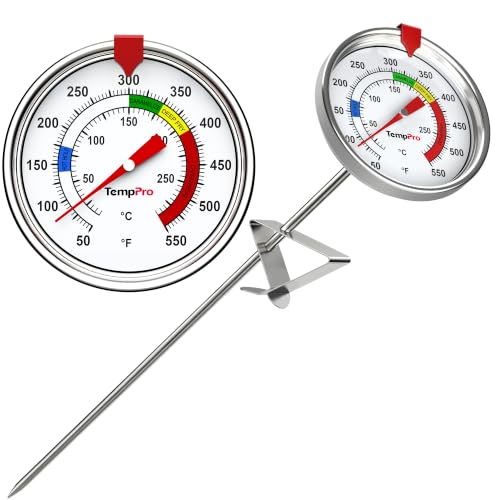
【9" Long Probe with Pot Clip】The frying thermometer for oil comes with a 9-inch probe and a secure pot clip, allowing it to be safely attached to cooking pots of different sizes, effectively protecting you from hot oil splatter

ACCURATE FAST READINGS (No More Burned Candy) --- Our candy deep fry thermometer provides instant and accurate temperature readings within seconds. Its advanced technology ensures precise measurements, allowing you to monitor the temperature of your food with confidence.
Key Usability Features for Candy Making
While temperature accuracy forms the foundation of candy-making success, the Thermapen’s design features are what actually enable you to achieve that precision in real-world kitchen conditions. The slim probe design minimizes sugar crystal nucleation and disruption in your syrup, while its quick-wipe surface maintains cleaning efficiency between readings. Your portable design allows you to conduct spot checks throughout the pot, capturing thorough temperature profiles that fixed thermometers can’t provide. The instant-read capability—under three seconds—supports rapid adjustments during critical cooking stages. Combined with the large backlit display showing tenths of degrees, you’re equipped to differentiate precisely between candy stages like soft ball and hard ball. This temperature precision, paired with practical usability, transforms your candy-making consistency and reproducibility. Additionally, some advanced thermometers have features that enhance cooking temperature monitoring, making them versatile for various culinary applications.

Fast & Accurate: Get precise readings in just 1 second with ±0.9°F accuracy. NSF Certified for trusted food safety, this digital food thermometer features a 4.3 inches food-grade stainless steel meat probe, perfect for grilling, frying, baking, making candy and more

【8X Faster + 4X More Precise】: Upgraded with an industrial-leading professional thermocouple sensor, Themomonster meat thermometer digital with NIST certified ±0.5℉ precision provides you the accurate temperature of your food in just 0.5 Seconds.

【Fast & Accurate】Our meat thermometer digital delivers accurate readings within ±1°F in just 1–2 seconds, with a wide temperature range of -58°F to 572°F (-50°C to 300°C). No more waiting over the heat - know your food's exact temperature instantly.
Temperature Range and Device Suitability
Because candy-making temperatures span a relatively narrow window—typically 230°F to 350°F—you’ll find the Thermapen’s thermal range of -58°F to 572°F not just adequate but deliberately oversized for your needs. This extensive capacity guarantees you can monitor all sugar stages, from thread through hard crack and caramel, without limitation. The oven-safe probe thermometers designed for continuous monitoring ensure that you achieve the precise temperatures needed for successful candy making, much like how the Thermapen provides accurate readings. The Thermapen ONE’s ±0.5°F accuracy proves critical when your temperature requirements demand precision. You can confidently track subtle shifts between stages, preventing texture failures caused by even minor temperature deviations. Fast readings allow you to spot-check without prolonged pot immersion, eliminating nucleation risks. Whether you’re working with fondant, brittle, or taffy, the device handles every sugar stage reliably, giving you repeatable results batch after batch. Additionally, proper food handling practices are essential to avoid textural issues while making candy.

【High Accuracy & Fast Reading】Digital candy thermometer get precise temperature readings in just 1 second with accuracy ±0.9°F, making it a smart choice for candy making and deep frying

Pot Clip Design for Safer Operation: This candy thermometer digital with clip can be fixed to the pot so you can free your hands to focus on the cooking, and protect your hands from the hot

Pot Clip Design for Safer Operation: This candy thermometer digital with a clip can be fixed to the pot so you can free your hands to focus on the cooking, and protect your hands from the hot
How Thermapen Compares to Traditional Thermometers
Although standard alcohol and digital thermometers can perform adequately in general cooking, they fall short of candy-making demands in several critical ways. Traditional thermometer issues include inaccuracy—some digital models read off by eight degrees—and slow response times requiring 10–20 seconds for stabilization. You’ll miss critical temperature windows when sugar races past doneness.
Thermapen’s candy making benefits are substantial. You’ll get readings in less than a second with ±0.5°F accuracy, enabling precise texture control. The cylindrical probe lacks crevices where sugar crystallizes, so you’ll wipe it clean with a damp towel. Its handheld design lets you spot-check multiple pot locations, revealing temperature variations traditional clip-mounted thermometers can’t detect. This mobility prevents localized overheating and guarantees consistent results. Additionally, the use of thermometers is crucial in both baking and candy making for achieving desired results in temperature-sensitive recipes. The accuracy of a digital probe thermometer is essential in ensuring that you reach the desired stages for candy making.
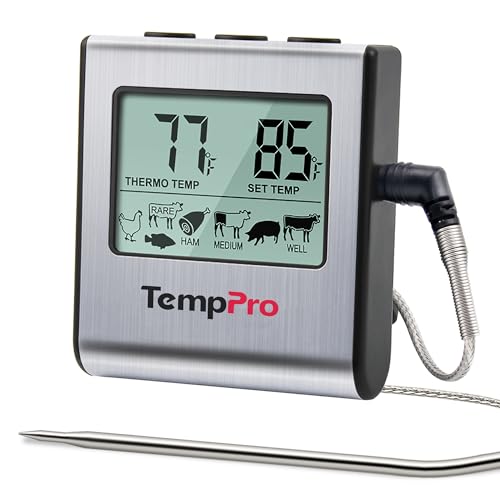
Cook mode with USDA preset temperature settings: TempPro cooking thermometer ideal for meat, oven, smoker or stove top; Programmable alert with preset temperatures for specific foods recommended by USDA; All of the preset temps can be reset to your desired tastes

Completely Waterproof: IPX6 waterproof rating means you can wash this cooking thermometer under running water without fear. This food thermometer for cooking ensures cleanup is ultra-fast

Fast and Accurate Reading: Kitchen thermometer for cooking features a 1 second readout speed and high accuracy of +/-0.9 degrees Fahrenheit, ensuring you receive the most delicious results every time
Professional Recommendations and Best Practices
Most professional candy makers and pastry chefs rely on the Thermapen for its unmatched combination of speed and accuracy, treating it as an essential tool rather than an optional accessory. Expert endorsements highlight its digital thermocouple technology‘s superiority over traditional alcohol or mercury thermometers, which suffer from fluid bubbles and sluggish response times.
For peak results, implement these usage tips: calibrate your Thermapen periodically to guarantee consistent performance, take multiple readings at different spots during cooking, and remove the probe quickly after each check to prevent heat loss. Start temperature checks early as your syrup approaches target temperatures, avoiding overshoot. Clean the probe immediately between readings to prevent sugar buildup from compromising accuracy. Avoid prolonged immersion, which interferes with sugar crystallization and temperature gradients.

EASY TO READ: It is easy to read the temperatures with the bright blue food-safe spirit.

ADJUSTABLE PAN CLIP FOR ANY SIZE POT: The built-in clip secures to pots and pans of all sizes, keeping the thermometer stable and hands-free so you can monitor candy stages or frying oil without constant attention.
Documenting and Adjusting Candy Textures
Your Thermapen’s precision becomes invaluable when you’re documenting temperature data to establish consistent candy textures across production batches. Record your probe readings at critical moments throughout the cooking process, creating a baseline reference for each candy type. When you notice texture inconsistencies—variations in hardness, brittleness, or crunchiness—correlate them directly to your temperature documentation. Small deviations of 1-2 degrees often explain why one batch differs from another. Use these records to make targeted texture adjustments by modifying cooking duration or heat intensity in subsequent batches. As you master the temperature control process, your documented temperature curves become essential troubleshooting tools, allowing you to identify where processing variations occurred. This systematic approach transforms raw data into actionable insights for achieving uniformity across all production runs.
Handling Limitations and Practical Challenges
While the Thermapen excels at rapid spot-checking, you’ll encounter practical constraints when relying on it as your primary candy-making thermometer. The probe limitations become apparent with uneven stovetop heat distribution, which creates temperature variations throughout your pot. You’ll need strategic sampling strategies, moving your probe around multiple zones rather than relying on single readings. Unlike clip-on candy thermometers designed for continuous immersion, the Thermapen isn’t built for prolonged submersion in hot syrup, risking damage or accuracy loss. The small probe tip contacts only one area at a time, potentially missing vital temperature pockets. While its compact design won’t interfere with stirring, you must commit to frequent manual checks, making it less convenient for hands-off monitoring during important cooking stages.
Spot-Checking vs. Continuous Monitoring
The Thermapen’s greatest advantage in candy making lies in its spot-checking capability, which fundamentally differs from traditional continuous-monitoring thermometers. When you remove the probe after each reading, you minimize nucleation sites that trigger unwanted crystallization. Continuous monitoring drawbacks include prolonged thermometer presence creating multiple crystallization points and uneven heat distribution readings within your pan.
Your spot checking benefits extend beyond crystallization prevention. You’ll stabilize temperature readings in under one second, enabling quick adjustments within tight candy-making windows. Traditional leave-in thermometers develop accuracy-reducing bubbles over time, whereas the Thermapen’s ±0.5°F precision supports fine-tuning for desired consistency variations. By spot-checking throughout your boiling process, you track temperature progression without compromising your candy’s final texture.