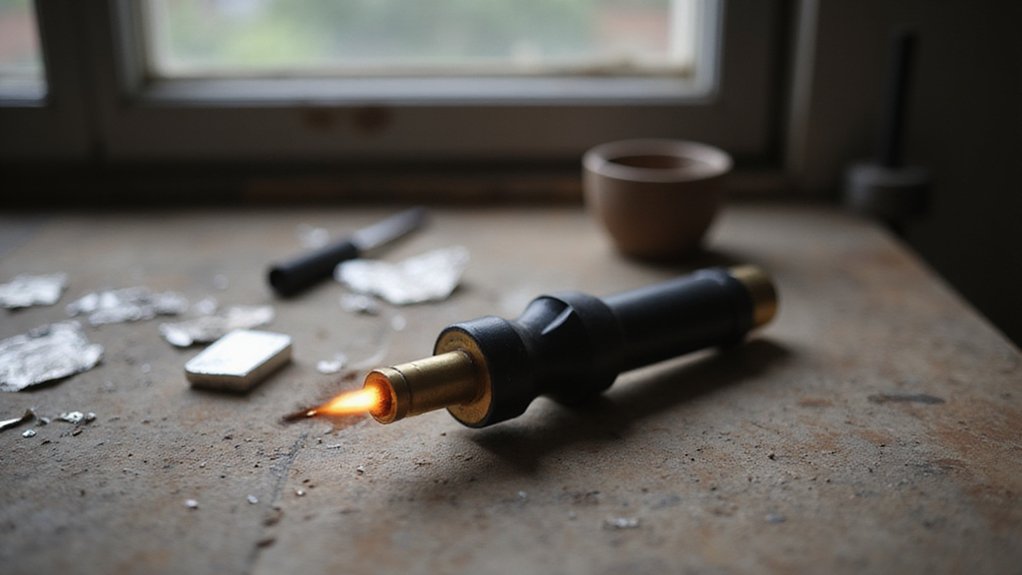
Trying to melt silver with a butane torch? It’s possible for small amounts, but it’s not straightforward. The torch can get hot enough, but silver’s high thermal conductivity makes it tricky to reach a reliable melt.
In this article, you’ll learn what setup and materials are needed to make it work effectively.
Melt Silver With a Butane Torch: Yes, but Marginally
While a butane torch can technically melt silver, its heat output is limited. Typically, it can handle melting up to around 40 grams of silver, but you need to optimize your setup for success. Use the smallest crucible you have—materials like ceramic or clay graphite are best because they heat quickly and hold temperature well. Preheat the crucible before applying direct flame; tilting the torch allows you to focus heat on the sides, speeding up the process. For a more reliable option, use a hose-connected torch model TS-4900 to prevent gas flow interruption when the container is low or tilted, ensuring stable heating. For consistent results, consider how superior heat retention and even heat distribution create a more uniform melting environment, similar to how a cast iron skillet sears a steak. Build a heat-retaining “igloo” from insulating fire bricks around your setup to conserve energy. For better heat delivery, consider alternative fuels like MAPP gas or air-acetylene, which produce higher temperatures. Unlike an infrared thermometer, which is less reliable for measuring the internal temperature of liquids, a digital probe thermometer would be ideal for monitoring the actual heat of the molten silver. With butane, you can still melt silver efficiently by using a flat-bottomed crucible placed on a charcoal block. Keep the torch flame directed into the crucible from above or from the side, ensuring consistent heating. Similar to the precise temperature control used in sous vide egg cooking, maintaining an accurate temperature is essential for successful silver melting. Remember, maintaining the right temperature until the silver spins is crucial; once it starts to melt and spin, remove your heat source immediately to prevent cooling and solidification before you pour.
Butane Torch Temperatures vs. Silver Melting Points
A butane torch can easily reach temperatures sufficient to melt silver, which has a melting point of 961.8°C. Consumer-grade butane torches typically burn at around 1,300 to 1,400°C, providing a surplus of 338 to 438°C above what’s necessary to melt silver. This excess heat ensures you can achieve melting efficiently and quickly, reducing the time your torch is in use. However, this heightened temperature also means you must take proper safety measures. The torch’s flame can be over 600°F hotter than required for melting silver, so protecting your workspace and yourself from intense radiant heat is essential. While most low-end torches provide enough thermal energy for melting silver, safety should always come first, and proper handling is key to avoiding accidents or damage. For example, using a cast iron skillet ensures even heat distribution and helps prevent accidental hotspots during the melting process.
Why Your Butane Torch Needs Insulation to Melt Silver
Because silver has the highest thermal conductivity of all metals, your butane torch’s heat escapes almost instantly without proper insulation. This makes a high flame temperature ineffective because the heat doesn’t stay concentrated on the silver. Instead, you’re battling silver’s ability to rapidly transfer heat away from your source. To compensate, you need insulation techniques that trap and retain heat around the crucible. Similar to how infrared thermometers are not currently recommended for precise health monitoring in dogs due to inaccuracy, relying on an uninsulated butane torch alone will likely fail to reach silver’s melting point reliably. The same principle applies when restoring a cast iron skillet, where vinegar spray solution is used to gently loosen rust without causing further damage to the metal. Just as oils with higher smoke points are generally preferred for optimal cast iron seasoning, choosing the right insulation method is critical for successful silver melting. Build a “little cave” with fire bricks or ceramic wool surrounding your crucible. This creates an adiabatic hot zone, preventing heat loss and maintaining consistent temperatures. Without this insulation, your crucible acts as a heat sink, pulling energy away from the silver and making it harder to reach its melting point. Preheat your crucible and apply borax flux to glaze its surface, which reduces heat absorption. Together, insulation and flux help funnel the furnace effect, enabling your butane torch to effectively heat the silver to 962°C. Continuous application of heat is essential, so consider using two torches if needed—insulation isn’t optional for successful melting.

Ceramic Fiber Insulation is high-temperature resistance, insulated, and fireproof. It is rated to 2400F so that it can maintain complete shape and size after the fire burns.

High Quality Material: Made from high-quality fiber for superior insulation and fire resistance, suitable for high temperature applications up to 2400°F.

Durable Fireproof Insulation: Designed for extreme heat environments, this ceramic fiber blanket offers outstanding fire resistance and insulation. It can withstand direct flame exposure with a continuous use temperature of up to 2700°F (1500°C), making it perfect for high-temperature applications
How to Melt Small Silver Pieces With a Butane Torch
To melt small silver pieces with a butane torch, you need to focus the intense heat precisely. Use a tiny crucible preheated to reduce heat absorption and a charcoal block to reflect heat back toward the metal. The torch’s blue flame cone reaches over 1200°C, well above silver’s melting point of 962°C. Keep the torch steady, aiming directly at the silver with a focused, uninterrupted flame. Avoid moving the flame around; maintaining consistent heat ensures even melting. Watch closely for the silver to form a spinning, liquid ball, which indicates it is fully molten. Hold the flame steady for another minute to guarantee complete liquefaction. Then, quickly pour the molten silver into a mold using pliers to handle the hot crucible safely. Unlike vacuum sealing, this process does not require specialized vacuum sealers to create an air-tight environment. This technique is similar to how a Dutch oven combines ingredients in a single vessel for efficient, flavorful cooking.

【High Performance】This mini torch can work with propane, acetylene, hydrogen, propylene, natural gas etc to finish jewelry repair work.Two connectors mix the oxygen and acetylene ( gas), to get high performance welding flame. The green one connect with oxygen and red connect gas (Acetylene/Butane/Propane)

A MUST-HAVE BUTANE TORCH FOR YOUR MASTERPIECES: Use the LEXIVON 12-piece butane powered soldering set in a wide range of different applications, from wood burning to wire soldering.

A MUST-HAVE BUTANE TORCH KIT FOR PROFESSIONALS: 13-Piece accessory set to use in a wide range of applications with self-igniting trigger and a flame locking button.
When a Butane Torch Isn’t Enough: Better Gas Options
If butane torches aren’t sufficient for melting silver quickly, you need a hotter gas source. Map gas and propane are two strong alternatives that provide more heat. With Map gas, you must enclose your crucible in a firebrick melting chamber because without insulation, it won’t reach the necessary temperature. Propane can significantly cut melt times—using two torches simultaneously can reduce melting to around four minutes. Pure MAPP gas also requires an insulated setup to reach silver’s melting point, as it delivers higher temperatures than butane. If speed is your priority, oxy acetylene offers the most powerful hand-held flame, melting silver even faster than other options. Upgrading your fuel and insulating your melting chamber can make a noticeable difference in efficiency and safety.

Note: Gas canister not included due to shipping rules. Ensure a tight connection before use. Turn knob 40–150° to ignite; avoid max power button to ignite. Adjust angle slightly if needed. Do not use at 90°. Detach canister after use and store separately.

MULTI-PURPOSE PROPANE TORCH: More than just a WEED BURNER; it is also great for melting snow and ice, removing parking lot markings and paint, thawing frozen pipes and equipment, melting tar and asphalt, repairing roof and various woodworking projects

【How do we ensure product safety】We crafted our blow torch out of professional-grade materials, providing you with a safe and easy-to-use tool. Premium Weed Torch with Security. Double-sealed barrels design ensure product safety.