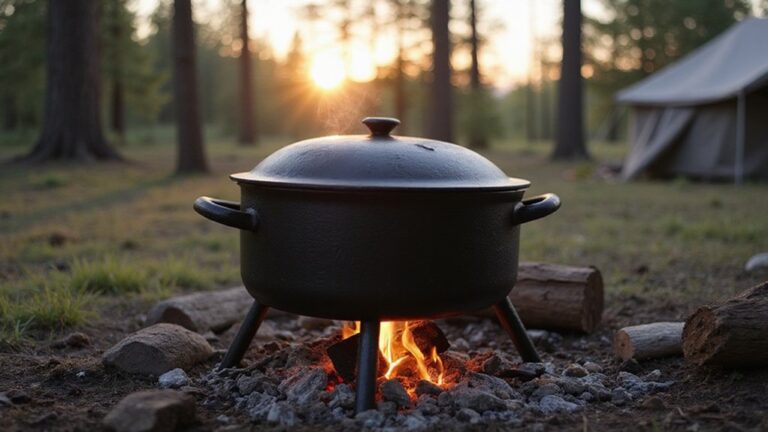
Struggling to get your Dutch oven cooking just right over a campfire? The key is knowing how to control the heat with coals so your meals don’t burn or turn out undercooked.
With about 24 briquettes, you can reach a steady 350°F using a specific setup of coals underneath and on top of your oven. Keep rotating the lid and the oven to ensure even cooking, and you’ll be set for a successful campfire feast.
The rest of the techniques and tips are right below.
Which Cast Iron Dutch Oven Size and Fuel Work Best for Camping
A 6-quart cast iron Dutch oven is ideal for camping with a family of 4 to 6 people, providing enough capacity for hearty stews, roasts, or multiple dishes at once. This size offers a good balance between volume and portability, making it versatile for different campfire cooking needs. When selecting your oven, ensure it features a snug, flat lid that can hold coals securely, which helps you manage heat more precisely during cooking. Pre-seasoned models are preferable because they require less maintenance and reduce the risk of rust, saving you time and effort while camping. The 6-quart size is a mid-sized, deep Dutch oven that balances weight and capacity, making it ideal for most campfire recipes without being too heavy to handle. Similar precise temperature control can be achieved using sous vide cooking for eggs, which requires preheating a water bath to exact degrees for consistent doneness. To prevent rust while camping, you can apply multiple seasoning rounds with a high-quality oil to protect the bare iron after any cleaning.
For fuel, hot briquettes are recommended because they deliver consistent heat and are easy to control. Use a 1:1 coal ratio for roasting, placing an equal amount of briquettes on top and underneath the oven, or a 2:1 top-heavy ratio for baking, with twice as many coals on top as below. Always place the Dutch oven on three legs if it has them—this airflow setup is essential for even heating and prevents scorching. Additionally, a lid with self-basting spikes helps keep food moist by evenly distributing condensation. With the proper size, secure lid, and correct fuel technique, you can enjoy reliable and efficient campfire cooking without hassle.

Suitable for 5-6 People: This 6qt Dutch oven is perfect for family meals or small gatherings, offering ample capacity for hearty dishes

Heavy-Duty Camping Cookware: Designed for campfire coals, the Lodge Seasoned Cast Iron Camp Dutch Oven uses a flanged lid to distribute heat above and below for even cooking

GREAT FOR CAMPING - Long legs & handles let this cast iron Dutch oven with lid sit OR hang over a fire. This outdoor cookware cast iron Dutch pot doubles as an oven with coals on top – this 3-in-1 large Dutch oven for fire does it all!
How Many Coals You Need for 350°F and 375°F Baking
To reach 350°F, use 24 briquettes for a 12-inch cast iron Dutch oven: 18 on top and 6 underneath. Increasing the top coals to about 21–22 briquettes raises the temperature to 375°F. For a 10-inch oven, 22 coals will give you 350°F. Maintain a 3:1 ratio of top-to-bottom coals to prevent burning. Environmental factors like cold, wind, or high elevation may require adding more coals—up to 27–30—to keep the temperature consistent. Always handle hot coals safely and adjust the amount of fuel cautiously to achieve steady, even heat during baking. Some sources caution that extreme heat can open the pores of the metal in cast iron, potentially leading to rust when the pan cools. Just as with FoodSaver bags designed for sous vide, these bags are manufactured to withstand high temperatures and are BPA-free, meeting FDA safety standards for cooking. However, standard Ziploc bags lack the necessary material thickness for reliable vacuum sealing, so specialized vacuum-compatible bags are recommended for sous vide.

Heavy-Duty Camping Cookware: Designed for campfire coals, the Lodge Seasoned Cast Iron Camp Dutch Oven uses a flanged lid to distribute heat above and below for even cooking

IDEAL FOR FAMILY MEALS - Perfectly sized for families of 3–5 people, this 5.5QT Dutch oven handles everything from hearty soups and stews to one-pot dinners, pasta dishes, and Sunday pot roasts. Spacious enough for a whole chicken yet practical for everyday cooking, it delivers the ideal balance between daily family meals and weekend entertaining. Also well-sized for artisan bread bakers who want one pot for both family dinners and sourdough baking.

Where to Place Coals for Even Heat and Consistent Baking
Arrange coals in two specific ways for optimal heat and baking consistency. For bottom heat, form a circular ring of at least ½ inch inside the oven’s edge—never place coals directly beneath the center. Space 2 to 3 briquettes between each of the three legs, totaling 6 to 9 coals for a standard three-leg oven. On the lid, create a checkerboard pattern or a continuous ring around the outer edge to maximize heat coverage. Additionally, place 2 to 4 coals near the handle to ensure even top heat. Avoid bunching coals in one area on the lid, as concentrated clusters can create hot spots that risk burning your food. For baking, use a ratio of three parts top coals to one part bottom coals. This setup delivers heat from above while maintaining evenness underneath. Proper heat distribution depends on careful placement, not guesswork—plan your coal arrangement deliberately for consistent results. For more precise temperature readings, digital probe thermometers are recommended as they measure actual internal temperatures much like candy syrups require for accurate results. This method closely mirrors the oven braising technique used for long-cooking dishes like short ribs, where steady heat ensures tender results. Such careful coal management also supports predictive maintenance in camp cooking by preventing sudden temperature spikes that could ruin a meal.

IDEAL FOR FAMILY MEALS - Perfectly sized for families of 3–5 people, this 5.5QT Dutch oven handles everything from hearty soups and stews to one-pot dinners, pasta dishes, and Sunday pot roasts. Spacious enough for a whole chicken yet practical for everyday cooking, it delivers the ideal balance between daily family meals and weekend entertaining. Also well-sized for artisan bread bakers who want one pot for both family dinners and sourdough baking.


YOUR NEW GO-TO LID LIFTER: The Lodge Camp Dutch Oven Lid Lifter keeps outdoor cooking safe and fun. It allows you to easily lift hot lids off your dutch oven as well as transport your dutch oven from an open flame to your table.
Rotate Every 15 Minutes to Prevent Hot Spots
Rotating your Dutch oven every 15 minutes is essential to prevent hot spots from developing. Hot spots occur because of uneven heat distribution caused by coals, wind, or the oven’s design. To counteract this, lift the oven by its wire bail, turn the body 90 degrees clockwise, and rotate the lid 90 degrees counter-clockwise at the same time. This opposite rotation helps neutralize concentrated heat, reducing the risk of burned food and uneven browning. Using the ring method of coal placement, where coals are arranged around the outside edge away from the legs, further enhances even heat distribution. For safe turkey cooking, a food thermometer is the most reliable method to ensure the internal temperature reaches 165°F in the thickest parts. Similarly, after each use, applying a light coat of oil prevents rust and maintains the skillet’s protective layer.
In windy conditions, increase the rotation frequency to every 4 to 5 minutes to maintain even heat. Skipping this step can compromise your seasoning’s protective layer and make it harder to clean, as food will stick more to hot spots. For baked goods, rotate more frequently during the first two-thirds of cooking to ensure even baking. Always set the legs back between coals to keep airflow consistent and avoid hotspots caused by airflow disruption.
Safety Gear and Cleanup Tips for Camp Cooks
To protect yourself from heat and fire hazards while handling your Dutch oven, always wear heavy-duty leather welding gloves and a leather apron. These provide essential shielding for your arms and torso from embers and hot surfaces. Use a metal lid lifter to avoid burns when removing or adjusting the lid, and always open the lid away from your face to prevent steam burns. Keep long pants and closed-toe shoes on, and tuck in loose clothing to avoid accidental ignition. These precautions help ensure your safety while managing fires and handling hot cookware outdoors.