

You’ll determine your infrared thermometer’s ideal distance using its Distance-to-Spot (D:S) ratio. A 12:1 ratio suits general applications, while 20:1 or 30:1 ratios work better for distant targets. Calculate maximum distance by dividing your target’s diameter by the spot size. Hold the thermometer perpendicular to your target, maintaining at least a 3×3 pixel coverage for accurate readings. Environmental factors like dust and moisture can shorten effective range considerably. Understanding these variables guarantees you’re measuring from the right distance for your specific application.
Understanding the Distance-to-Spot Ratio
The distance-to-spot (D:S) ratio—a fundamental specification for infrared thermometers—defines how the measurement area expands as you increase your distance from a target. Represented as a ratio like 12:1, it means at 12 units of distance, you’re measuring a 1-unit diameter spot. This specification directly impacts your measurement precision and distance accuracy. A higher D:S ratio enables you to measure smaller targets from greater distances, making it vital for selecting the right thermometer. You’ll find that 12:1 ratios suit general applications like HVAC work, while 20:1 or 30:1 ratios help you reach high-temperature environments safely. Understanding your thermometer’s D:S ratio guarantees you maintain accurate readings by keeping your measurement spot fully contained within your target surface.

Wide Temperature Range: Measures temperatures from -58℉ to 1112℉ (-50℃ to 600℃), making it perfect for a variety of applications, including cooking, pool maintenance, oven temperature checks, and candy making

TG54-2 Measures Temperatures ranging from -30°C to 850°C (-22°F to 1562°F) from safe distance using infrared technology with a 20:1 laser spot ratio

【Measures Up to 2732°F – Extreme Heat Ready】: This high-precision infrared thermometer gun measures surface temperatures from -58°F to 2732°F (-50°C to 1500°C), the widest range in its class, perfect for high-temperature applications such as pizza ovens, furnaces, kilns, welding, and forging industrial use. No more switching between multiple tools
Calculating Maximum Measurement Distance
Now that you understand how your thermometer’s D:S ratio shapes the measurement spot, you’ll need to calculate the actual maximum distance you can maintain accurate readings. You’ll divide your target diameter by the spot size diameter derived from your D:S ratio to determine feasible distance. For example, a 50:1 ratio thermometer measuring a 2-inch target can operate effectively at approximately 100 inches. However, measurement challenges emerge when targets fall below twice the field-of-view diameter, introducing background temperature interference. Proper calibration techniques guarantee your instrument’s sensor sensitivity remains ideal across distances. Consider environmental factors like atmospheric absorption and dust that degrade signal strength, potentially shortening your effective range. Account for these variables when planning measurements to maintain accuracy.
Field of View and Accuracy Considerations
Since you’ve calculated your thermometer’s maximum measurement distance using the D:S ratio, you’ll now need to evaluate how field of view directly impacts your measurement accuracy. Your target must cover at least a 3×3 pixel area for reliable readings; smaller targets produce skewed results as the spot size averages surrounding temperatures. High tilt angles enlarge your effective measured area, distorting accuracy despite FOV calibration adjustments. Your sensor’s spatial resolution (IFOV) critically determines thermal signal separation between target and background. When background surfaces contaminate your measurement zone, even emissivity corrections can’t compensate for fundamentally incorrect spot sizing. Minimize distance or narrow your FOV to guarantee your spot completely covers the target, maintaining measurement precision and eliminating background interference that compromises data integrity.
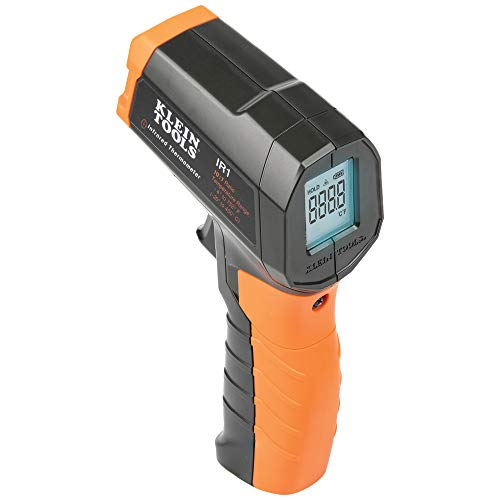
PRECISE TEMPERATURE MEASUREMENT: Optical resolution (distance-to-spot) of 10:1 ensures accurate temperature readings from a distance

Compact Type K | Infrared dual measurement - Measure temperature your way—use the folding rod for in-duct readings or the 8:1 infrared sensor for fast surface and ambient checks
![Metris Instruments Mini Digital Infrared Thermometer Certified to UL4200A Reese’s Law for Reptiles, Playground, Automotive, [ -27.4° to 428 °F ] (-33° to 220 °C) 1:1 D:S Ratio, Model TN002PC NO Laser](https://m.media-amazon.com/images/I/31257lIYzVL._SL500_.jpg)
MINI INFRARED THERMOMETER: The MINI thermometer pen provides speed and accuracy when measuring surface temperatures; it’s one of the most advanced miniature infrared thermometers; it has a D:S Ratio of 1:1; (EX: measure a 1 inch area at 1 inch)
Medical Applications and Safe Distances
While infrared thermometers excel at non-contact temperature measurement, you’ll find their medical applications demand strict adherence to specific distance protocols to balance accuracy with safety. You should maintain a consistent 3–5 cm distance from a clean, dry forehead, holding the sensor perpendicular to the skin surface. You’ll achieve ideal accuracy by avoiding hair, hats, or obstructions that compromise readings. Environmental factors like sweat and forehead conditions considerably affect measurement reliability. Additionally, you must account for medication effects that may alter surface temperature perception. Infrared thermometers are valuable for measuring surface temperature in various applications, but they still require attention to distance and positioning. You will reduce cross-contamination risks greatly through non-contact screening, though frequent device disinfection remains essential. You should receive proper training to understand how distance, positioning, and patient stability directly influence clinical diagnostic reliability in medical settings. To achieve optimal readings, using a very hot skillet for proper cooking techniques can parallel how precision temperature management is vital in both culinary and medical fields.

✨Swift Results in Just 1 Second: Experience the efficiency of ANMEATE thermometer for adults with its remarkable 1-second read capability. Obtain accurate temperature readings swiftly, providing you with timely and dependable results.

No-Contact Thermometer: GoodBaby touchless thermometer provides contactless accurate temperature reading that helps you avoid cross infections. No need to clean the thermometer after every use
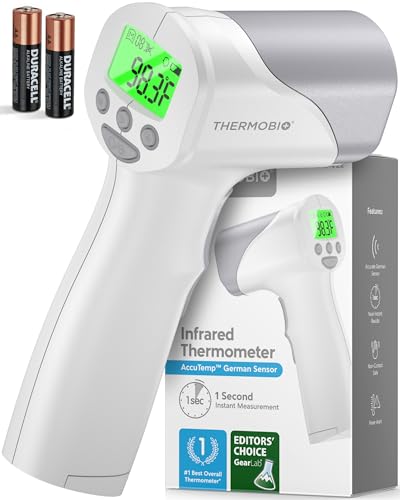
Advanced Technology: Superior performance delivered by the latest smart chip utilizing an optimized algorithm to ensure the 3 ultra sensitive sensors precisely measure your temperature to hygienically deliver accurate results, faster, safer, and more reliably.
D:S Ratios for Different Use Cases
The Distance-to-Spot (D:S) ratio you select fundamentally determines your infrared thermometer’s effectiveness across distinct applications, as each industry demands specific trade-offs between measurement precision, target accessibility, and operational safety. You’ll find that industrial applications requiring D:S ratio implications of 30:1 to 50:1 enable remote monitoring of furnaces and electrical equipment from safer distances. For cooking accuracy, you’ll use 8:1 to 12:1 ratios, allowing reliable skillet temperature checks from convenient distances. Electrical safety demands higher ratios to prevent operator exposure to hazardous environments. HVAC effectiveness relies on 8:1 to 12:1 ratios for duct and refrigerant line assessment. Maintenance precision improves considerably when you match your device’s ratio to target size and accessibility, ensuring accurate readings without thermal contamination from surrounding heat sources. Additionally, understanding specific thermometer types can enhance your measurement strategy for various cooking methods.

【Ultimate Versatility for Kitchen, Garage & House】Ideal for a multitude of tasks! Check pizza oven or griddle heat for perfect cooking, monitor HVAC system vents, or safely diagnose automotive repair issues like overheating engine parts, all with our infrared thermometer gun

NOT FOR HUMAN: Temperature readings from these devices are inanimate objects. for humans or animals will not be correct. For the best accuracy the distance between thermometer and object of measurement should approximately be 14.17 inches

【Highly Accurate & Adjusts to Any Surface】Designed with the latest thermopile sensor technology, the infrared laser thermometer gun is accurate to +/-1.5%; Improve this pizza oven thermometer gun measurements by adjusting the emissivity from 0.1–1.0 to match the surface material being measured
Optimal Positioning and Alignment Techniques
How you position and align your infrared thermometer directly determines whether you’ll capture accurate target temperatures or inadvertently average readings from surrounding surfaces. You should hold the thermometer perpendicular to your target surface at a 90° angle for ideal measurement consistency. Angled measurements increase your effective spot size and introduce errors from reflected or ambient temperatures. For curved surfaces, aim for the most perpendicular angle possible to the measurement area’s center. Your angle adjustments matter considerably because non-perpendicular alignment causes the thermometer to average temperatures from adjacent surfaces, reducing accuracy. On flat surfaces, maintaining perpendicularity ensures the smallest possible spot size and minimizes measurement error. Always verify that your entire measurement spot remains on the intended target before recording results. Furthermore, take note that infrared thermometers only measure surface temperature, which underscores the importance of proper alignment to ensure accurate readings. To ensure effective temperature measurement, remember that infrared thermometers measure surface temperatures rather than air temperature directly, emphasizing the need for precise positioning.

𝐕𝐞𝐫𝐬𝐚𝐭𝐢𝐥𝐞 𝐓𝐨𝐨𝐥𝐬: Infrared technology allows you to measure various objects at home and outdoors; Use it for 𝒎𝒆𝒂𝒕, 𝑫𝑰𝒀 𝒄𝒂𝒏𝒅𝒚, 𝒐𝒗𝒆𝒏𝒔, 𝒈𝒓𝒊𝒍𝒍𝒊𝒏𝒈, 𝒇𝒐𝒐𝒅, 𝒄𝒐𝒐𝒌𝒊𝒏𝒈, 𝒂𝒖𝒕𝒐𝒎𝒐𝒕𝒊𝒗𝒆 𝒖𝒔𝒆, 𝑨/𝑪, 𝒓𝒆𝒇𝒓𝒊𝒈𝒆𝒓𝒂𝒕𝒐𝒓𝒔, etc.

PRECISE TEMPERATURE MEASUREMENT: Optical resolution (distance-to-spot) of 8:1 ensures accurate temperature readings from a distance
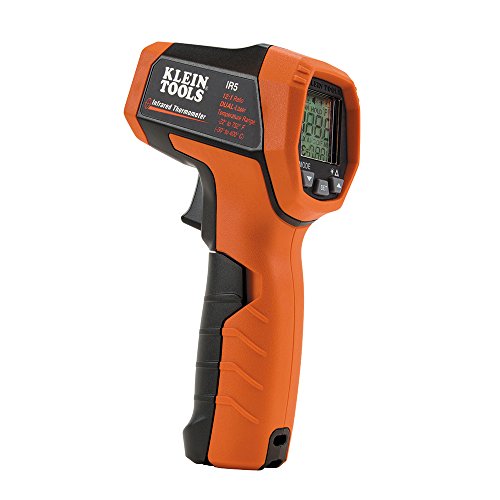
PRECISE TEMPERATURE MEASUREMENT: Optical Resolution (Distance-to-spot) of 12:1 ensures accurate temperature readings from a distance
Environmental Factors That Impact Readings
Achieving precise positioning and alignment sets the foundation for accurate infrared thermometry, but your measurement environment can still introduce significant errors that compromise results. Atmospheric interference from dust, steam, and smoke scatters infrared radiation, reducing signal intensity at your sensor. You’ll encounter humidity effects when relative humidity exceeds 85 percent, causing measurement variability and degrading performance. This may affect the accuracy of temperature readings, as infrared thermometers have shown limitations in sensitivity to detect fever accurately. Water vapor and fog scatter infrared energy away from your detector, while moisture on measured surfaces artificially lowers temperature readings. Temperature fluctuations between environments introduce errors ranging from 5 to 6 degrees Fahrenheit, requiring 20 to 30 minute acclimation periods. Extended measurement distances amplify these atmospheric effects through increased particle interference. You must account for these environmental factors when interpreting results and selecting measurement locations within ideal operating ranges of 60.8 to 104 degrees Fahrenheit. Additionally, it’s important to remember that non-contact infrared thermometers are designed specifically to measure temperature safely without the risk of harmful radiation exposure.
Maintenance and Calibration for Reliable Measurements
While proper positioning and environmental awareness establish the groundwork for accurate infrared thermometry, you’ll need consistent maintenance and calibration protocols to maintain measurement reliability over time. Follow manufacturer recommendations for calibration intervals, performing recalibration before critical measurements or annually for regular use. You should calibrate at two points minimum—ice water (0°C) and boiling water (100°C)—to verify accuracy across your operating range. Calibrating your device at these reference points ensures that your thermometer remains reliable throughout its use. Essential maintenance tips include keeping your lens clean, storing the device in a protective case, and replacing batteries regularly to prevent performance degradation. Check alignment and measurement distance using laser guidance or mechanical fixtures. Record all calibration adjustments for quality control documentation. These practices guarantee your infrared thermometer delivers dependable, traceable measurements throughout its operational life. Additionally, just as with cooking, simple dessert recipes often require precise temperature control for the best results.


