Wondering if you can bake sourdough bread in a ceramic Dutch oven? The good news is yes, you can, but it requires a gentle approach to avoid cracking.
Using it correctly can help trap steam and give you a beautiful crust, though you might need a little extra baking time.
Keep reading for all the tips to make it work perfectly.
Yes, You Can Bake Sourdough in a Ceramic Dutch Oven
Ceramic Dutch ovens are effective for baking sourdough, though they don’t radiate heat as intensely as cast iron. They still trap steam well, which is crucial for achieving good oven spring. Brands like Emile Henry offer gradual heating that prevents thermal shock and protects your dough. Since ceramic retains heat more gently, you can bake at a slightly lower temperature, around 425°F instead of 450°F. Extending the covered baking time by 5 to 10 minutes helps the loaf rise fully and develop a crisp crust. The steam retention provided by ceramic helps set the crust beautifully, often reducing the need for longer uncovered baking. For those restoring cast iron, vinegar spray solutions can remove rust within 30 minutes, but ceramic requires no such treatment. In contrast, the precise control of a sous vide water bath allows for perfect egg textures by holding a steady temperature. Overall, ceramic performs nearly as well as cast iron for sourdough baking, delivering bakery-quality results with some minor adjustments to internal temperature and baking time.
How to Preheat Without Cracking the Ceramic
Preheating ceramic cookware gently is essential to prevent cracking. Start by placing the empty ceramic pot in a cold oven, then set the temperature to 350°F. Allow it to heat gradually for 30 to 40 minutes, ensuring slow, even heat distribution. Use an instant-read thermometer to monitor the temperature, keeping it between 340°F and 360°F. Do not exceed 425°F, as higher temperatures increase the risk of microcracking. Never put a cold ceramic pot into a hot oven or set a hot pot onto a cold surface; always use a trivet to protect the cookware and your countertop. For enameled ceramic models, adding a tablespoon of oil before heating creates a protective layer on the surface, reducing the chance of damage. Similar to the way you must use a neutral flame to avoid overheating the base aluminum when brazing, careful temperature control is key to preserving ceramic cookware. The Dutch oven’s thick cast iron and tight-fitting lid allow for even heat distribution and moisture retention, enhancing flavor while cooking. These careful steps help maintain the integrity of your ceramic cookware, similar to how a cast iron skillet provides even cooking and easy handling for other baked dishes.

IDEAL FOR FAMILY MEALS - Perfectly sized for families of 3–5 people, this 5.5QT Dutch oven handles everything from hearty soups and stews to one-pot dinners, pasta dishes, and Sunday pot roasts. Spacious enough for a whole chicken yet practical for everyday cooking, it delivers the ideal balance between daily family meals and weekend entertaining. Also well-sized for artisan bread bakers who want one pot for both family dinners and sourdough baking.

IDEAL FOR FAMILY MEALS - Perfectly sized for families of 3–5 people, this 5.5QT Dutch oven handles everything from hearty soups and stews to one-pot dinners, pasta dishes, and Sunday pot roasts. Spacious enough for a whole chicken yet practical for everyday cooking, it delivers the ideal balance between daily family meals and weekend entertaining. Also well-sized for artisan bread bakers who want one pot for both family dinners and sourdough baking.

Quality Enameled Dutch Oven: The Lodge Essential Enamel Cast Iron Dutch Oven gives you all the benefits of cast iron cooking, great heat retention and durability, without fear of rust; it's also PFAS free
Transfer and Score Your Dough Like a Pro
Using a parchment paper sling is the most efficient way to transfer and score your dough like a pro. Start by cutting a piece of parchment paper 2 to 3 inches longer than your proofing basket to create handles. Invert the dough onto the parchment sling, taking care to maintain tension. The hydration level and folding techniques you used earlier influence how easily the dough releases; properly developed dough will come away cleanly. This successful release relies on the dough having been patiently developed through proper autolyse and stretch and folds, which build the strength needed to hold its shape.
Score immediately after flipping the dough onto the parchment. Hold your lame at a 15 to 20 degree angle and cut about half an inch deep to allow for optimal oven spring. Use a single, confident slash to avoid deflating the loaf. Pre-cut parchment handles serve as guides, ensuring you don’t disturb the dough’s tension during scoring. Following these steps helps you achieve clean cuts and maximum expansion in your oven, especially when baking in a preheated ceramic Dutch oven.
Add Steam for a Crunchy Crust (Ice Cubes Work Best)
Adding ice cubes is the simplest way to generate steam for a crunchy crust. Use 2 to 4 ice cubes to avoid cooling the vessel too much, which can lead to a soggy crust. Place the cubes between the parchment paper and the edge of the preheated ceramic Dutch oven, not directly on the dough. This setup creates a barrier that prevents wet spots on the surface. Maximizing oven spring depends on the steam delaying crust formation for about 15 to 20 minutes. For best results, add the ice immediately before sealing the lid. After 20 minutes, remove the lid to allow the crust to brown and develop a crisp texture. If your crust sets too quickly or an ear does not form, using ice often helps to correct these issues by providing the necessary steam. The dough should be smooth and jiggly from proper gluten development after the 4 sets of stretch and folds. To ensure the steam is fully effective, the ceramic Dutch oven must be held perpendicular to the heat source for even distribution, much like the correct technique that prevents temperature inaccuracies when using a non-contact thermometer. Preheating the vessel properly is critical for even heat distribution and to avoid sticking or uneven baking. This method is similar to how a Dutch oven peach cobbler relies on the vessel’s even heat distribution for a perfect golden crust.

Quality Enameled Dutch Oven: The Lodge Essential Enamel Cast Iron Dutch Oven gives you all the benefits of cast iron cooking, great heat retention and durability, without fear of rust; it's also PFAS free

AMAZING CAPACITY: The large capacity of our Dutch ovens meets many culinary needs such as cooking, baking, stewing and more. The maximum temperature resistance is 500°F, ensuring that the iron pan can still maintain stable performance in high temperature cooking environment.

Self-circulating Lid:This dutch oven pot is design with circulating shower type lid, designed to catch steam as it rises in the pot & condense the steam back into water inside the lid,evenly fall on the food to maintain the original nutrition.
Ceramic vs. Cast Iron: Which Dutch Oven Wins for Sourdough?
Cast iron outperforms ceramic when it comes to durability and heat retention. Its material is highly resilient, capable of withstanding high temperatures without damage. Cast iron preheats safely to 450°F, which makes it ideal for achieving a consistent, scorching hot surface crucial for sourdough baking. Ceramic knobs and handles, however, are more prone to cracking or breaking under high heat, and many are not rated for oven use. The high thermal mass of cast iron also means it retains heat exceptionally well, helping to maintain stable oven temperatures once heated. This consistent heat prevents the sourdough’s crust from prematurely softening and ensures even baking. Additionally, its loop handles are designed to support heavy loads, allowing you to handle the hot, heavy vessel more securely. For long-term reliability and optimal sourdough crust development, cast iron is the superior choice. Maintaining its seasoning with a light coat of oil after each use is essential to prevent rust and preserve its non-stick surface. In contrast, for candy making, digital probe thermometers are recommended over infrared models for measuring the internal temperature of syrups with reliable accuracy.

Even Heat Distribution Retention: This Umite Chef Dutch oven Made with heavy-duty enameled cast iron, ensures even heat distribution for perfect searing and slow cooking, locking in flavors. thickened walls lock in heat for slow braising, searing, and baking. Unlike thin pots that scorch food, this professional-grade Enameled cast iron potSuperior heat retention after preheating (allow 5-7 mins for even distribution). CRITICAL: Always cool naturally for 45+ mins before cleaning. Thermal shock (hot-to-cold contact) cracks enamel. USE TIP: Preheat 2-3 mins on medium-low only
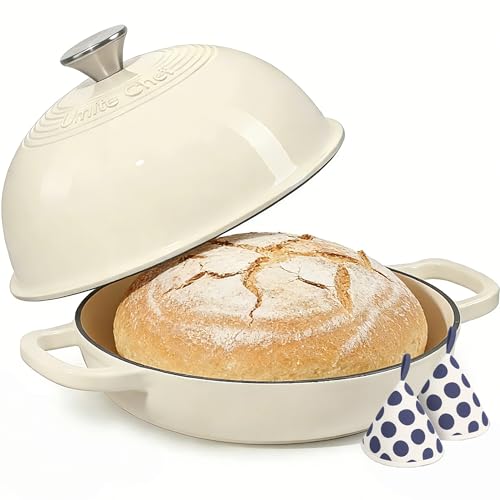
Achieve Professional Artisan Bread at Home - Expertly designed for bread baking, this 6 qt cast iron bread oven creates the ideal steam baking environment. Crafted from high-quality cast iron, it ensures superior heat retention for a crispy, golden crust and impressive oven spring—just like a bakery. The domed cloche lid traps moisture perfectly, guaranteeing delectable results every time

Achieve Professional Artisan Bread at Home - Expertly designed for bread baking, this 6 qt cast iron bread oven creates the ideal steam baking environment. Crafted from high-quality cast iron, it ensures superior heat retention for a crispy, golden crust and impressive oven spring—just like a bakery. The domed cloche lid traps moisture perfectly, guaranteeing delectable results every time This explicitly states that this is a premium, delicate kitchen item that requires careful handling to maintain its beauty and durability