

For a standard 500g flour sourdough loaf, you’ll need a minimum 5-quart Dutch oven. Round models work best for boules, while oval designs suit batards. If you’re working with higher hydration doughs, opt for 5–7 quarts to accommodate proper expansion. Cast iron outperforms enamel for superior heat retention and crust development. Guarantee your Dutch oven’s depth exceeds 4–5 inches to facilitate adequate oven spring. The specific dimensions you choose will greatly influence your loaf’s final shape and crumb structure.
Ideal Dutch Oven Sizes for Sourdough Bread Baking
Why does Dutch oven size matter so much for sourdough? Your Dutch oven directly influences how your dough expands during baking. You’ll want a 5-quart minimum for a 500g flour loaf, though 4–5 quarts suits round boules while 5–7 quarts accommodates oval batards. Size selection depends on your flour type and dough hydration levels—higher hydration doughs require additional headroom for expansion. Since dough volume roughly doubles during baking, you’ll need a pot approximately twice your shaped dough’s volume. Sizes smaller than 4 quarts restrict expansion and complicate handling. Larger 6–7 quart options offer flexibility for bigger loaves or multiple bakes. Furthermore, using a pot that retains heat and moisture is crucial for creating the perfect environment for a crusty, bakery-style loaf that achieves that ideal combination of rise and crust development. Match your Dutch oven capacity to your typical loaf weight and shape for consistent, well-risen results.

Even Heat Distribution Retention: This Umite Chef Dutch oven Made with heavy-duty enameled cast iron, ensures even heat distribution for perfect searing and slow cooking, locking in flavors. thickened walls lock in heat for slow braising, searing, and baking. Unlike thin pots that scorch food, this professional-grade Enameled cast iron potSuperior heat retention after preheating (allow 5-7 mins for even distribution). CRITICAL: Always cool naturally for 45+ mins before cleaning. Thermal shock (hot-to-cold contact) cracks enamel. USE TIP: Preheat 2-3 mins on medium-low only

EXCELLENT HEAT RETENTION: Our dutch oven crafted with durable cast iron with a glossy enamel that ensures distributing heat evenly and retains heat nicely. Ideal for slow-cooking dishes, as the cast iron pot maintain a steady temperature throughout the cooking process. Made of food-grade material without any chemicals. Non-toxic, PFOA & PTFE free. Plus, unlike other conventional cast iron dutch ovens, you can stew acidic sauces and soups without leaving behind an unpleasant metallic taste.

2-in-1 Versatile Cookware Design: The Lodge Cast Iron Double Dutch Oven is a Dutch oven and dual-handle skillet in one smart design, expanding your options for searing, baking, frying, and more
Effects of Dutch Oven Size on Bread Shape and Texture
Because your Dutch oven’s dimensions directly constrain or permit dough expansion during baking, you’ll notice significant variations in your loaf’s final shape and internal structure.
Smaller Dutch ovens restrict lateral expansion, directing growth vertically and producing taller, narrower loaves with enhanced oven spring. Conversely, larger Dutch ovens permit horizontal spread, yielding wider but slightly lower breads that open more prominently along scoring lines.
Shape variety extends beyond height and width. The vessel’s geometry—round, oval, or rectangular—directly influences your loaf’s final form, ensuring your bread mirrors its container.
Texture differences prove equally pronounced. Smaller ovens generate tighter crumb structures as vertical rise dominates expansion patterns. Larger ovens facilitate more open crumb development through increased lateral space, allowing superior dough extension. These texture differences remain measurable yet modest when identical doughs bake under consistent conditions, with crumb moisture content remaining stable regardless of Dutch oven volume. Additionally, understanding the influence of cooking methods can further enhance your bread-baking results, ensuring optimal outcomes with your Dutch oven.
Baking Considerations by Dutch Oven Size
Your Dutch oven’s dimensions fundamentally impact how efficiently heat transfers to your dough, affecting everything from preheating time to final crust development. Smaller 4–5 quart ovens preheat quickly and stabilize temperature efficiently, supporting superior oven spring through concentrated heat retention. Cast iron skillets can also help achieve similar results when properly preheated and utilized in place of a Dutch oven. Larger vessels require extended preheating and slightly longer baking times due to greater internal volume.
When implementing baking techniques, start all sizes at 500°F for 20–30 minutes with the lid on to trap steam. Then reduce temperature to 460–475°F revealed for 20–35 minutes, adjusting duration based on your oven’s size advantages. Monitor internal loaf temperature—reaching 195°F to 205°F indicates doneness regardless of pot dimensions. Remember that depth must exceed 4–5 inches to allow proper upward expansion without lid obstruction. Additionally, consider using alternatives like a cast iron skillet for effective steam trapping if a Dutch oven is not available.
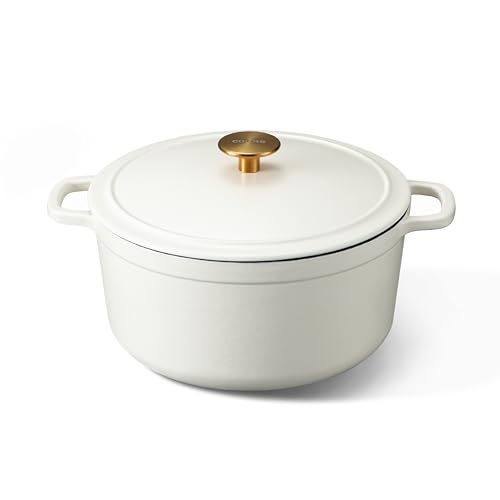
Superior Even Heat Control: One-piece thick cast iron delivers uniform heat with zero hot spots and excellent heat retention, ideal for searing, braising and crusty bread baking. Preheat on medium-low heat; cool naturally before washing to prevent enamel cracking.

PFAS-FREE & NON-TOXIC COOKWARE: ATTENTION: If your manual mentions "enamel" or "low-medium heat only", it is incorrect. This is 100% pure cast iron cookware! Not Enamel-Coated: Safe for High-Heat Cooking! Metal utensils OK (avoid sharp edges) Every Umite Chef cast iron pot has been burned with 100% natural, food-grade vegetable oils—absolutely zero PFAS, PFOA, PTFE, synthetic coatings, or toxic chemicals. Our seasoning naturally builds with use, developing a superior non-stick surface over time while ensuring oven-to-table safety

Floral Gift Set Design: Classic enamel Dutch oven with elegant floral print, functional & decorative. Complete set: pot, lid, cotton potholder, oven mitts & matching gift box, ideal for gifting.
Shape Compatibility and Dutch Oven Type
Once you’ve selected your Dutch oven size, matching it to your intended loaf shape becomes critical for best baking results. Round Dutch ovens excel with boule loaves, while oval models suit batards perfectly. Your Dutch oven shapes directly influence baking techniques and final outcomes.
Round Dutch ovens (4Q–5Q) accommodate 500g flour boules with adequate depth for proper rise. Additionally, the Dutch oven’s ability to retain heat ensures an even baking environment, contributing to an exceptional crust. Oval Dutch ovens (5Q–7Q) handle similar flour weights in batard form, offering greater flexibility. Cast iron Dutch ovens outperform enamel alternatives, delivering superior heat retention and crust development. Verify manufacturer heat limits on enamel models, as extreme temperature changes cause chipping. Additionally, Dutch oven desserts can enhance your camping experience, providing a sweet conclusion to your outdoor meals.
Regardless of Dutch oven type, confirm your lid fits tightly for steam retention. This seal proves essential to your baking techniques’ success, whether you’re shaping boules or batards.

Crock Pot Artisan Round Enameled Cast Iron Dutch Oven, 5-Quart, Blush Pink w/Lid

5 QT FAMILY SIZE – PERFECT FOR ONE POT MEALS: Spacious 5 quart dutch oven ideal for soups, stews, pasta, casseroles and pot roast. Wide base for better browning and deep sides for family dinners. Perfect cast iron pot for meal prep and everyday cooking.

Porcelain enameled exterior both durable finish land rich in colors complements any kitchen dcor. Cast iron contraction retains heat well. The porcelain enameled interior is perfect for cooking: surfaces do not impact flavors or absorb odors.
Practical Tips for Choosing Dutch Oven Size
Since Dutch oven dimensions directly influence loaf shape and oven spring, you’ll want to prioritize both capacity and internal geometry when making your selection. Your baker’s preference for loaf height versus width should guide your choice—select smaller pots for taller, rounder loaves or larger vessels for wider, flatter shapes. Material choices matter too; cast iron retains heat effectively, supporting consistent crust development across size variations. Consider your dough weight and desired oven spring characteristics when evaluating depth and diameter. Measure internal dimensions carefully, accounting for how lids and handles reduce usable space. Matching your Dutch oven size closely to your dough volume for ideal results is crucial because inadequate space can hinder the ideal oven spring. Remember that proper preheating duration varies with pot size, requiring approximately one hour at 500°F for adequate thermal mass. Additionally, a 3-quart Dutch oven can work successfully for bread baking as long as bakers adjust their dough quantities proportionally to fit the smaller size.
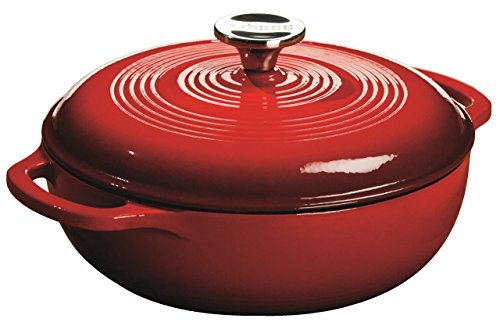
YOUR GO-TO DUTCH OVEN: A flawless pairing of form and function that doesn't quit. The Lodge Dutch Oven not only makes your kitchen look good but is an enameled cast iron classic great for preparing and serving memorable meals. Broil, braise, bake or roast your favorite meals in the oven up to 500 Degree F.

A KITCHEN NECESSITY: Our COMMERCIAL CHEF 3.4-quart cast iron Dutch oven is a must-have for kitchen novices and culinary experts alike. This thick cast iron cooking pot with lid insulates heat so that your meals will be well-cooked.
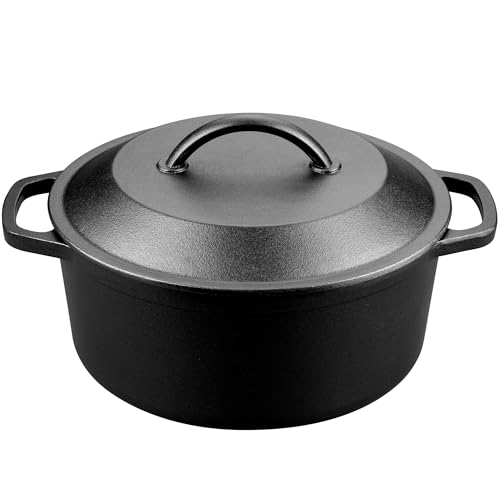
VERSATILE USE: The bread dutch oven with lid is perfect for baking sourdough and homemade sandwich loaves with crispy crusts and soft interior; beyond baking bread, this cast iron bread pan is also perfect for slow-cooking, simmering, braising, baking, Boiling, or roasting a wide range of recipes.
How Dutch Oven Depth Impacts Oven Spring
Dutch oven depth fundamentally shapes how your loaf rises and sets during baking. Deeper vessels extend oven spring dynamics by prolonging steam retention importance, which keeps your crust pliable longer. This extended moisture exposure channels your dough’s expansion upward rather than outward, producing taller loaves with greater final height. Additionally, the superior heat retention of the Dutch oven enhances the baking process, contributing to the development of a perfectly baked crust.
Shallow ovens accelerate crust formation, causing premature hardening that entraps your loaf and curtails oven spring. Conversely, deeper Dutch ovens moderate crust setting while maintaining uniform heat distribution around your dough. This combination supports sustained vertical rise and more controlled expansion.
When you match your Dutch oven depth to your shaped dough height, you optimize the balance between steam retention and heat exposure. This alignment maximizes oven spring potential and produces the dramatic rise you’re seeking in artisan sourdough. Additionally, understanding proper temperature control is crucial to achieve consistent baking results with your Dutch oven.
Recommended Dutch Oven Measurements for Sourdough
Three critical measurements—capacity, interior diameter, and depth—determine whether your Dutch oven will ideally support your sourdough’s rise and crust development. You’ll find that a 4.5 to 5.5 quart capacity with an 8.5 to 9.5 inch interior diameter suits most standard recipes. Your Dutch oven should hold roughly twice your shaped dough’s volume, allowing proper expansion during baking.
For 500-gram flour recipes, you’ll need a 5 to 6 quart vessel; larger formulas require 6 to 7 quarts. Dutch oven materials—typically enameled cast iron—affect heat distribution and crust quality considerably. Match your vessel to your baking ratios: dough weights between 600 and 900 grams fit standard sizes, while 900 to 1,200 grams demand larger options. Professional bakers often maintain multiple sizes for recipe flexibility.

【Superior Heat Mastery & Durability】Engineered with premium enameled cast iron and solid integral molding, our Dutch oven delivers exceptional, even heat distribution and unmatched heat retention for perfect searing and slow cooking. For best practices, we recommend starting on medium-low heat for 5-7 minutes before increasing the high temperature. After cooking, allow the pot to cool down naturally before cleaning—avoid placing a hot Dutch oven pot directly under cold water to protect the enamel coating from sudden temperature changes.

Even Heat Distribution Retention: This Dutch oven Made with heavy-duty enameled cast iron, ensures even heat distribution for perfect searing and slow cooking, locking in flavors. thickened walls lock in heat for slow braising, searing, and baking. Unlike thin pots that scorch food, this professional-grade Enameled cast iron pot maintains steady temperatures

Quality Enameled Dutch Oven: The Lodge Essential Enamel Cast Iron Dutch Oven gives you all the benefits of cast iron cooking, great heat retention and durability, without fear of rust; it's also PFAS free


