You’ll want to evaluate eight critical dimensions: type (external versus chamber), vacuum strength near 99.9%, sealing modes matching food moisture levels, user-friendly controls, bag compatibility and thickness requirements, optional attachments like jar sealers, power capacity matching your frequency, and extensive warranty coverage. These factors directly impact food waste reduction up to 50% and ROI within 4-8 months. Understanding how each dimension interconnects reveals why certain models outperform others for your specific needs.
Understanding the Two Main Types of Vacuum Sealers
When you’re choosing a vacuum sealer, you’ll encounter two fundamentally different designs: external and chamber models, each operating on distinct principles that affect their performance with various food types. External sealers clamp around bag openings, using suction to remove air—a method that works well for dry foods but struggles with liquids since moisture interferes with seal integrity. Chamber sealers, conversely, evacuate air from both the bag and surrounding chamber simultaneously, enabling consistent seals across wet and marinated foods. Understanding these sealer comparisons reveals critical distinctions in vacuum strength and reliability. Your user preferences regarding food variety, storage volume, and kitchen space should guide your selection between these fundamentally different technologies. Additionally, choosing the right vacuum sealer can significantly enhance your meal prep by extending food freshness while preventing spoilage and freezer burn. Vacuum sealing food properly can also help extend the shelf life of vacuum sealed meats, ensuring they maintain quality for years in the freezer.
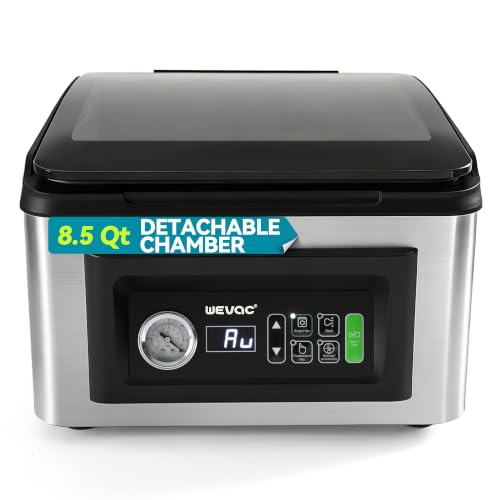
No Guesswork with Auto Vacuum Time: Manual timers often lead to under- or over-vacuuming. This chamber sealer automatically senses the food volume and sets the optimal vacuum cycle for you. One touch is all it takes to achieve a perfect, airtight seal—every time

【𝐃𝐮𝐚𝐥 𝐕𝐚𝐜𝐮𝐮𝐦 𝐙𝐨𝐧𝐞𝐬 & 𝟔 𝐋 𝐂𝐡𝐚𝐦𝐛𝐞𝐫】Seal liquids, soups, and powders in the roomy upper chamber (approx. 6 L / 300 × 260 × 80 mm). The upper chamber is bag-friendly, working with smooth chamber bags and textured or embossed rolls—from small pouches to larger bags that fit inside—so it isn’t picky about bag types. For bags that can’t fit in the chamber, the independent lower work area handles out-of-chamber sealing with compatible rolls.

Wider Seal for Leak Reduction: The chamber vacuum sealer quickly extracts air before sealing. Its 10 mm wide heat seal creates a secure, tight closure for clean, leak-free sealing
Evaluating Vacuum Strength and Sealing Performance
How effectively your vacuum sealer removes air directly determines how long your food stays fresh and how well it’s protected from oxidative decay. You’ll want to evaluate vacuum pressure measurement through leakage rate (QL), pressure change (Δp), and chamber volume to understand your sealer’s extraction efficiency. Top-performing units achieve vacuum levels near 99.9%, minimizing residual air that compromises shelf life.
For sealing quality evaluation, you should assess how uniformly your heating elements fuse bag materials and whether the seal maintains integrity across temperature cycles. Consider helium mass spectrometry testing for detecting minute leaks and compression set measurements for evaluating elastomer seal durability. Consistent vacuum pressure throughout each cycle prevents weak points that lead to leaks. You’ll find that reliable vacuum pump technology directly correlates with stronger, more dependable seals suitable for long-term food storage. Vacuum sealing can also extend your food’s freshness by minimizing air exposure, which is crucial for maximizing shelf life.

【Clear Vacuum Bags】Our sealable vacuum bags are made of high quality materials can withstand high temperature, food save bags Boilsafe,Freezable and Reuseable.

Dollar Saver: Preserve food up to 3 years in the freezer, maintaining its freshness and taste

Compatible with All Desktop Vacuum Sealers: These vacuum sealer bags are designed to work with all traditional desktop vacuum sealer machines. Simple to operate and convenient to use. (Note: These bags do not feature an air valve and are not compatible with handheld vacuum sealers.)
Assessing Multiple Sealing Modes for Different Foods
Your vacuum sealer’s effectiveness extends beyond raw suction power—it depends equally on your ability to match sealing modes to the specific characteristics of different foods. Different sealing modes address distinct food textures and moisture levels, preventing common failures like crushed berries or punctured bags filled with liquids. Dry mode handles grains and snacks efficiently, while moist mode protects foods with high water content by adjusting suction strength and sealing duration. Additionally, mastering vacuum sealing is crucial for maintaining the quality and longevity of frozen foods. Pulse or gentle modes preserve delicate items without damage. Double seal mode reinforces integrity for long-term storage. By selecting appropriate modes based on your food’s composition, you’ll reduce sealing failures, enhance food safety, and maintain ideal freshness. This tailored approach guarantees reliable performance across diverse ingredients without compromise. Additionally, utilizing vacuum seal bags effectively helps in extending the shelf life of food items significantly, preserving their quality and nutritional value.

Easy Use Design: No scissors required for these bags. Just align to seal and tear to open.
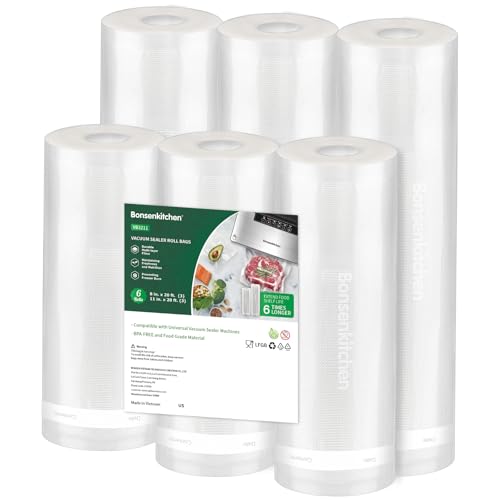
BPA FREE: Bonsenkitchen vacuum food sealer roll bags can be microwaved, frozen, re-used, washed, boiled and dishwasher safe. Allows you to precisely control your cooking temperature to achieve perfect results. You can cook sous vide in Bonsenkitchen bags by placing them in water at any temperature up to 230°F/110°C

6X Freshness Preservation Airtight Seal: Our premium vacuum sealer bags for food extend shelf life by 6x, sealing in freshness, flavor and nutrients fully. Blocks freezer burn, moisture and odors, outperforming ordinary storage bags.
Considering Ease of Use and Convenience Features
Because a vacuum sealer’s technical capabilities mean little if you can’t operate it intuitively, ease of use and convenience features become critical differentiators in your purchasing decision. User friendly controls and intuitive interfaces streamline your sealing workflow considerably. Full color touch screens simplify navigation, while water-resistant keyboards enhance durability and cleaning convenience. One-touch automatic vacuum sealing minimizes your operational effort, allowing you to focus on food preparation rather than equipment management. Programmable settings enable you to customize vacuum levels for specific foods, ensuring ideal results without manual adjustment. Integrated bag storage and cutters reduce setup time between seals. Preset functions deliver consistent results and save you time during large batch operations. These convenience features collectively transform vacuum sealing from a technical chore into an accessible, efficient preservation method.

【Suitable for two types of Mason jars】The electric Mason jar vacuum sealer contains two sizes of mouth seals for your daily use. To get the standard mouth seal jar, simply insert the red arrow on the standard mouth seal converter, align it with the unlock symbol on the main unit and then insert it inside the silicone ring in the wide mouth seal area and tighten it clockwise, at this point the arrow is aligned with the lock symbol, which indicates a successful installation.

EASY VACUUM SEALING SOLUTION - This vacuum sealer for food makes meal prep and storage easy. Preserve freshness with automatic air sealing perfect for dry or moist foods. Save time and money while reducing food waste with the integrated roll cutter.

80kpa Suction Power - Updated vacuum sealer uses a DC motor pump with electromagnetic perm and pure copper core to enhance its suction power. It sucks all air out tightly to preserve your meat and vegetables for 10 times longer or more to prevent oxidation.
Matching Bag Compatibility With Machine Type
Even the most intuitive vacuum sealer performs poorly with incompatible bags, making bag selection as important as machine operation itself. You’ll need embossed bags for edge sealers, as their channelled texture enables efficient air extraction through external suction. Chamber sealers, conversely, require flat bags—using embossed bags in these machines wastes resources and compromises results.
Your sealing techniques depend directly on bag compatibility. When you match bag dimensions to your machine type, you optimize vacuum performance and prevent spoilage. Universal embossed bags work reliably with most edge sealers, offering flexibility without brand-specific requirements.
Consider bag thickness (9–10 mil for short-term, 11.5–12 mil for long-term storage) alongside your sealer type. Universal options from reputable manufacturers deliver consistent results while accommodating both pre-cut bags and custom-sized rolls, enhancing operational flexibility without sacrificing performance.
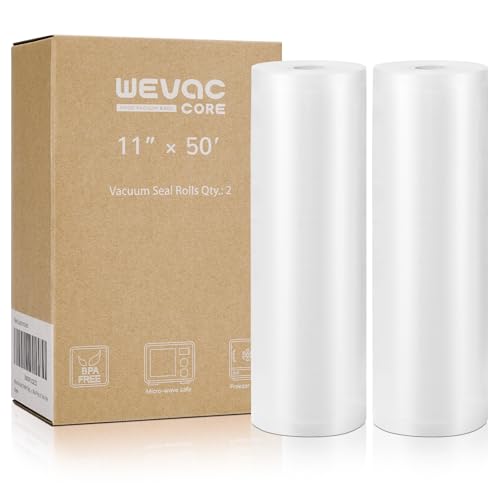
HEAVY DUTY AND PUNCTURE PREVENTION - 2 pack of 11 inch by 50 feet rolls with embossed channels to increase suction, keep fresh without freezer burn or dehydration

Safe Materials and Versatile Cooking Options: BPA Free - Sous Vide - Boil in the bag - Microwave friendly **ALWAYS PUNCTURE BAG BEFORE USING IN THE MICROWAVE** - Made of Food Grade PA/PE - BPA and Phthalate Free

ECONOMICAL & & TIME SAVING: Total 150 count Bonsenkitchen 20 Gallon 11" x 16"+ 80 Quart 8" x 12"+ 50 Pint 6" x 10" vacuum sealer bags are different sizes of packaging, meet your different usage needs. Vacuum bags are pre-cut and ready-to-use, saving you time whenever you’re preserving leftovers, preparing make-ahead meals, and portioning bulk items in the freezer.Just pull out and use, no need to cut, no need to seal one side before putting food in
Exploring Additional Functionalities and Attachments
How can you maximize the utility of your vacuum sealer beyond basic bag sealing? You’ll find that advanced models offer jar canister sealing attachments, greatly expanding your preservation options for dry goods and liquids. These require compatible sealing ports or adapters for peak performance.
Marinating sous vide capabilities represent another valuable enhancement. Specialized marinating modes accelerate flavor infusion through pressure application, reducing typical preparation times from hours to minutes. Simultaneous sous vide readiness demands waterproof seals that withstand water immersion without compromising integrity.
Additionally, dual vacuum pumps dramatically increase throughput by removing air faster and achieving higher vacuum pressures, directly correlating with extended shelf life. Adjustable sealing settings accommodate varying food textures and moisture levels, protecting delicate items from crushing. Liquid sensors automatically prevent pump damage when handling wet foods, ensuring reliability across diverse applications. In contrast, using a standard vacuum cleaner is inadequate for food preservation, as it cannot create a proper seal or vacuum for vacuum sealing food.
Determining the Right Size and Power Requirements
Selecting the appropriate vacuum sealer size and power requires careful alignment between your machine’s specifications and your intended use case. You’ll need to match your vacuum sealer’s voltage and power specifications with your local electrical system to prevent overload. Consider the machine’s physical size dimensions relative to your available workspace—commercial chamber sealers demand substantial counter space, while compact external models suit limited areas.
Vacuum power directly impacts sealing efficiency; stronger pumps extract air more effectively from bags, particularly essential for dense or liquid-rich products. You should prioritize power capacity that matches your sealing frequency and product volume rather than selecting based solely on machine dimensions. Higher-powered commercial-grade sealers handle frequent, large-volume operations, whereas household models accommodate lighter sealing needs with reduced footprints and lower electrical demands.
Calculating Long-Term Cost and Warranty Protection
While upfront costs for vacuum sealers vary dramatically—from $30 for basic household models to $4,500+ for commercial-grade machines—you’ll find that long-term financial analysis reveals substantial ROI across virtually all applications. You’ll recover your investment within 4-8 months through food waste reduction alone, with commercial operations realizing $12,000 in annual savings. When calculating long-term savings, factor in maintenance cost reductions of approximately 32% over ten years with quality stainless steel components. Extended equipment lifespan adds significant value—vacuum packaging prevents corrosion, extending tool life by 18-24 months. Warranty features become critical in your total cost of ownership projections. Commercial-grade machines rated for 25+ years provide extended protection, justifying premium investments through durable construction and modular designs that minimize replacement frequency.