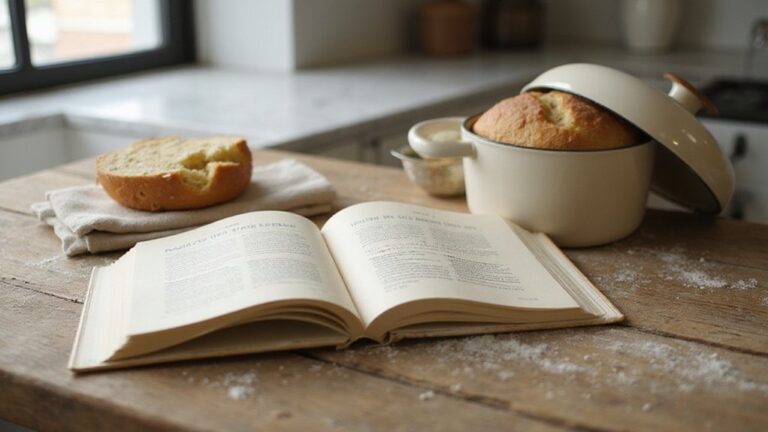
You’ll coat your Dutch oven with cornmeal or brown rice flour to prevent sticking, then dust your dough with semolina or flour before transfer. Use a floured peel or cutting board to invert your banneton and slide the dough into your preheated 450°F Dutch oven smoothly. The vessel traps steam, creating that coveted crusty exterior while you maintain even heat throughout baking. Master these fundamentals, and you’ll uncover advanced techniques that elevate your loaves further.
Parchment Paper Alternatives
While parchment paper’s convenience makes it a popular choice for Dutch oven bread baking, you’ll find several practical alternatives that’ll reduce waste and offer distinct advantages. Silicone mats provide a reusable solution lasting up to 3000 baking cycles with proper care, offering excellent non-stick surfaces for bread transfer. You can also apply a cornmeal coating directly to your Dutch oven’s base, which prevents sticking while creating a textured bottom crust. Brown rice flour serves as an effective alternative coating. For precise control, you’ll dust your greased pan with flour, tapping out excess before adding dough—this method requires attention to prevent flour burning at high temperatures. Each approach eliminates single-use waste while maintaining reliable release performance. Notably, using a Dutch oven ensures that the even, dry heat is circulated, mimicking an oven environment for successful baking. To enhance your bread’s flavor further, consider incorporating herbs and spices that can transform simple dough into a more complex, aromatic loaf.

PERFECT NON-STICK RELEASE: Our non-stick surface prevents sticking to hot Dutch ovens, preserving loaf shape and crust; the bread sling won't stick to dough for clean, frustration-free release

Silicone Baking Mats With Handles: Eliminate the risk of burning your hands, our silicone bread sling updated extra Longer and widen handle design(7.2"*3.7") with lift ring for more safety transfer dough to Dutch oven pot and avoid burnt your hands when Bread in and out Dutch Oven Pot

Easy Dough and Bread Transfer: Long handles make it easier to lower proofed dough into a Dutch oven and lift the finished loaf out after baking
Preparing Your Dutch Oven
Once you’ve selected your preferred release method, you’ll need to prepare your Dutch oven itself—the vessel that’ll become your bread’s baking environment. Start with thorough cleaning methods: wash enameled Dutch ovens with mild soap and dry completely, or wipe uncoated cast iron with a dry cloth to eliminate residual moisture that causes uneven baking.
Next, lightly oil the interior using a high smoke-point neutral oil like vegetable or canola. Apply with a brush or paper towel for even coverage, avoiding excess that creates greasy crusts. Additionally, maintaining even heating is crucial to ensuring a well-baked loaf.
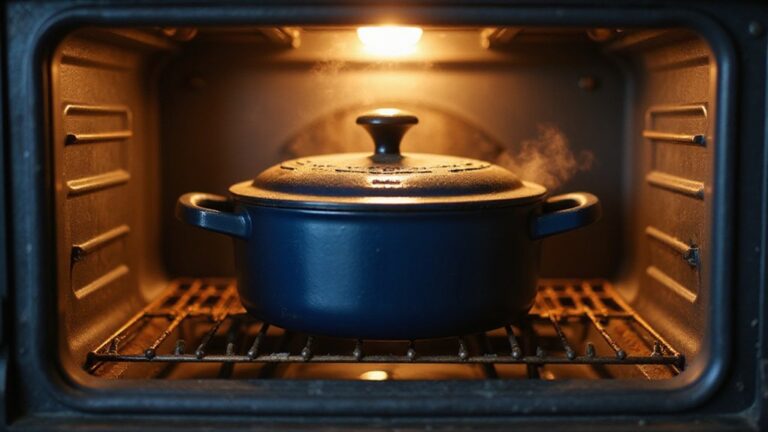
Finally, implement preheating techniques by placing your Dutch oven in a 450°F oven for 30 to 45 minutes—extending to 60-90 minutes maximizes heat retention. Proper preheating both pot and lid ensures best steam trapping and crisp crust formation. Always handle with heat-resistant gloves and place on heat-safe surfaces.
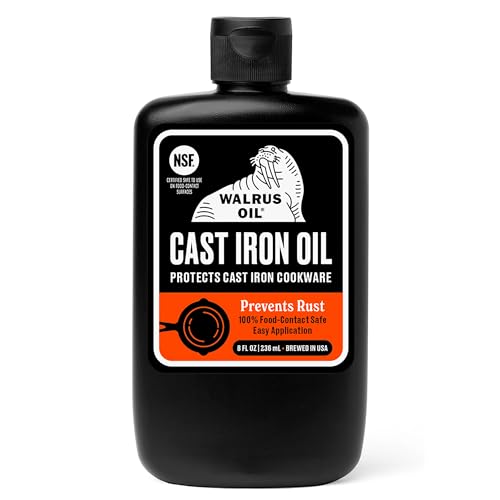

🌱 100% SEED-OIL FREE: Free from soy, grapeseed, canola, and sunflower oils.

CAST-IRON COOKING: Our round cast-iron press features a perfectly textured preseasoned skin that transfers and retains heat while helping your meats to cook more quickly. We use only non-GMO, kosher-certified flaxseed oil to season it, and it’s PTFE- and PFOA-free for healthier cooking.
Preventing Dough From Sticking
Even with thorough preheating, you’ll need to create a physical barrier between your dough and the Dutch oven’s hot surface to prevent sticking. You can dust your dough surface with flour types like semolina or cornmeal before transfer—these granular materials insulate effectively while preventing direct contact. Cooking techniques like caramelizing onions can enhance the preparation of the bread dish while ensuring flavor depth.
Alternatively, apply oil techniques using vegetable oil-based non-stick spray to the pot bottom, then dust with flour to create a dry protective layer. This dual-layer approach provides superior adhesion prevention.
For maximum protection, combine multiple strategies: dust cornmeal into the preheated Dutch oven, spray lightly with oil, then dust additional flour over the oiled surface. Remove your bread after approximately 30 minutes when the crust firms, reducing prolonged contact with the pot’s interior. Additionally, using classic recipes may inspire you with different approaches to Dutch oven cooking.
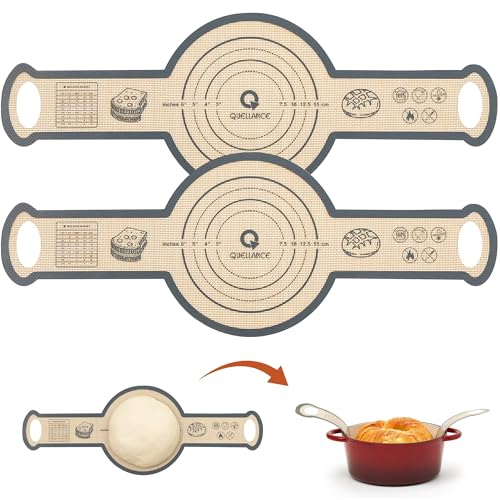
Silicone Baking Mats With Handles: Eliminate the risk of burning your hands, our silicone bread sling updated extra Longer and widen handle design(7.2"*3.7") with lift ring for more safety transfer dough to Dutch oven pot and avoid burnt your hands when Bread in and out Dutch Oven Pot
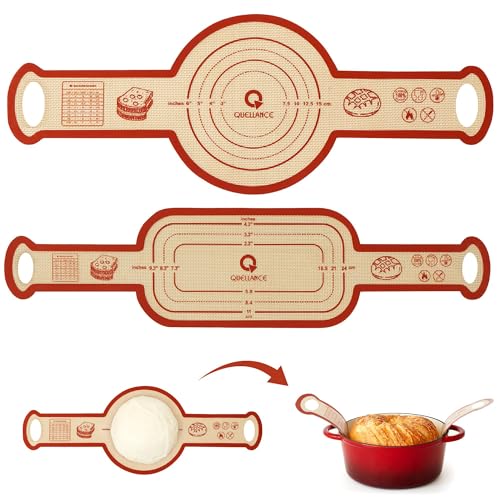
Silicone Bread Sling 2 Sizes: Come with 2 sizes of silicone bread slings, X-Large oval one is 11'' and Large round one is 8.3'' in diameter, fits all Dutch ovens 4Qt and above. It includes measurement marks to help you roll out dough to the perfect thickness and size

7 QUARTS OVAL CAST IRON DUTCH OVEN. Choose the perfect black dutch oven for bread baking. This 7 quarts oval large-sized oven-safe dutch oven is perfect for 6-person meals, cooking for a crowd, and simmering a stew.
Transferring Dough Successfully
After your dough’s final proof completes, you’ll need to move it from its banneton or proofing bowl into the preheated Dutch oven with precision and care. Employ dough handling techniques that preserve structure: invert the banneton onto a floured peel or wooden cutting board, then slide the dough directly into your 500°F Dutch oven. Use controlled, smooth motions—avoid jerky movements that cause deflation. Transfer preparation tips include having heat-protection gloves ready, clearing your workspace of obstacles, and removing the Dutch oven from heat momentarily for better control. If dough sticks, gently separate edges with a bench scraper before lifting. Cooking meat at a low temperature can also help maintain its structure, which is crucial for baking bread. Score immediately after transfer to minimize handling distortion and guarantee peak oven spring and crust development. Additionally, ensure that your baking surface is well-oiled to prevent sticking, just as you would restore cast iron cookware to maintain its nonstick properties.

The Ultimate 9-in-1 Pro Bread Baking Kit – From Beginner to Artisan. This complete set is engineered for perfect homemade bread, covering the entire workflow: a 5QT Enameled Cast Iron Sourdough Bread Oven (with lid), 10inch Rattan Proofing Banneton, Stainless Steel Dough Scraper, Bread Sling, Dough Whisk, Bread Scoring Lame, Cleaning Brush, and Heat-Resistant Gloves. No need for extra purchases. Ideal for sourdough, no-knead, rustic bread, and even meatloaf.

Superior Enameled Cast Iron Structure: Upgraded thick cast iron body with food-safe enamel coating delivers fast even heating and long-lasting heat retention. No regular seasoning required, anti-rust and anti-corrosion for daily kitchen cooking

The Ultimate 9-in-1 Pro Bread Baking Kit – From Beginner to Artisan. This complete set is engineered for perfect homemade bread, covering the entire workflow: a 5QT Enameled Cast Iron Sourdough Bread Oven (with lid), 10inch Rattan Proofing Banneton, Stainless Steel Dough Scraper, Bread Sling, Dough Whisk, Bread Scoring Lame, Cleaning Brush, and Heat-Resistant Gloves. No need for extra purchases. Ideal for sourdough, no-knead, rustic bread, and even meatloaf.
Baking and Finishing Your Bread
With your dough now settled in the preheated Dutch oven, you’ll manage the baking process through careful timing and temperature control to develop both crust and crumb. Maintain 450°F during the initial 20-35 minutes of covered baking, then remove the lid for 5-15 minutes to promote browning and crust hardening. Adjusting temperatures prevents over-browning while ensuring proper caramelization. Monitor doneness by checking for golden-brown color, listening for a hollow sound when tapping the bottom, and verifying internal temperature reaches 190°F–210°F. A properly preheated Dutch oven helps to create the steam necessary for optimal oven spring. After baking, cooling bread on a wire rack for at least 30 minutes allows steam to escape, preserving crust crispness and improving flavor development. Avoid slicing immediately to prevent crumbling and gummy texture. Utilizing a Dutch oven is particularly advantageous because it traps steam during the baking process, which helps create that ideal crusty exterior.
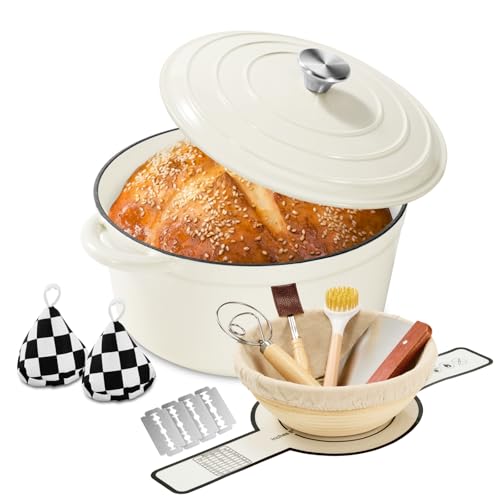
【For Effortless Cooking & Easy Cleaning 】Featuring a seven-layer design, this Dutch oven ensures even heat distribution and retention. The enamel coating resists sticking, and facilitates easy cleanup, saving you time and effort in the kitchen

【ALL YOU NEED】Complete set includes 5QT sourdough dutch oven with frying pan lid,bread proofing basket, bread sling, stainless steel scraper, cleaning brush, bowl scraper, wooden-handled dough whisk, bread lame, silicone oil brush,silicone spatula. Sourdough starter kit with dutch oven is ready to use out of the box!
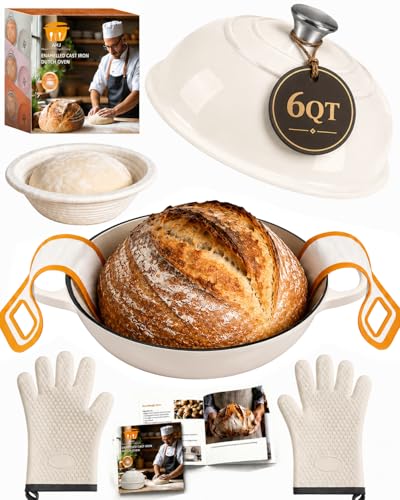
PROFESSIONAL BREAD BAKING EXPERIENCE: Achieve artisan-quality sourdough and crusty loaves with our 6QT cast iron bread oven and included banneton basket. The traditional dome design traps steam naturally, while easy-to-follow recipes help beginners and experts master homemade bread.